Managing parents' medications from abroad
Parents in Poland while you live abroad? See how to keep oversight of their medications from another country with a shared kit, expiry alerts and a refill list.
Ten at night in Amsterdam, ten at night in Poland — the same hour, two countries. Magda calls her mum with the question she asks every day: “Mum, did you take your evening medications?” Mum says she thinks so. “Thinks” is the operative word here. Magda will not look in the drawer, count the tablets in the blister pack, or check whether the heart medication is running out. Between her and her mum’s medicine kit there are a thousand kilometres and one “I think so.”
This article is about that specific situation — your parents stayed in Poland, you live abroad, and you want real oversight of their medications even though you will never open that drawer yourself. This is not medical advice and it will not replace your parent’s doctor. It describes how to organise a scattered family medicine kit so that “I think so” turns into “I can see it.”
Let us rule out two neighbouring topics it gets confused with right away. This is not a guide to a travel kit and what to pack for a trip abroad — that is about a single trip. It is also different from remote management of a senior’s kit within one country, where you can drop in and look from time to time. Here the border sits between you permanently, and that changes three things at once.
Three problems that look different when a border sits between you
When you live in the same city, most things to do with a parent’s kit can be sorted out with a visit. When a border separates you, the same things get harder — not because they are more complicated, but because the obvious solutions disappear.
You cannot look in the drawer. It sounds trivial, but it is the heart of it. You will not count the packs, see the date on a box, or notice an antibiotic that has been open for six months. Every scrap of information about the state of the kit has to reach you somehow, and phone calls and photos in a messenger are unreliable, because they depend on whether someone remembered.
Different brand names for the same medication. This trap is typical of families split by a border. A medication you know under one name in your country of residence is sold in Poland under another, and sometimes the other way round. When mum says “I take the pink one for my blood pressure” and you try to line that up with what you know from the local pharmacy, the brand name leads nowhere.
A different pharmacy and doctor system, and a different time zone. Your parent’s prescription is in the Polish system, their doctor practises in Poland, and the pharmacy they use keeps Polish hours. You are on a different daily rhythm and in a different healthcare system. Coordinating “live” is often simply impossible.
The good news is that the app has an organisational answer to each of these three problems. It does not treat anyone or decide for the doctor, but it makes the facts stop depending on memory and on who happens to pick up the phone.
One shared cloud kit — everyone sees the same thing
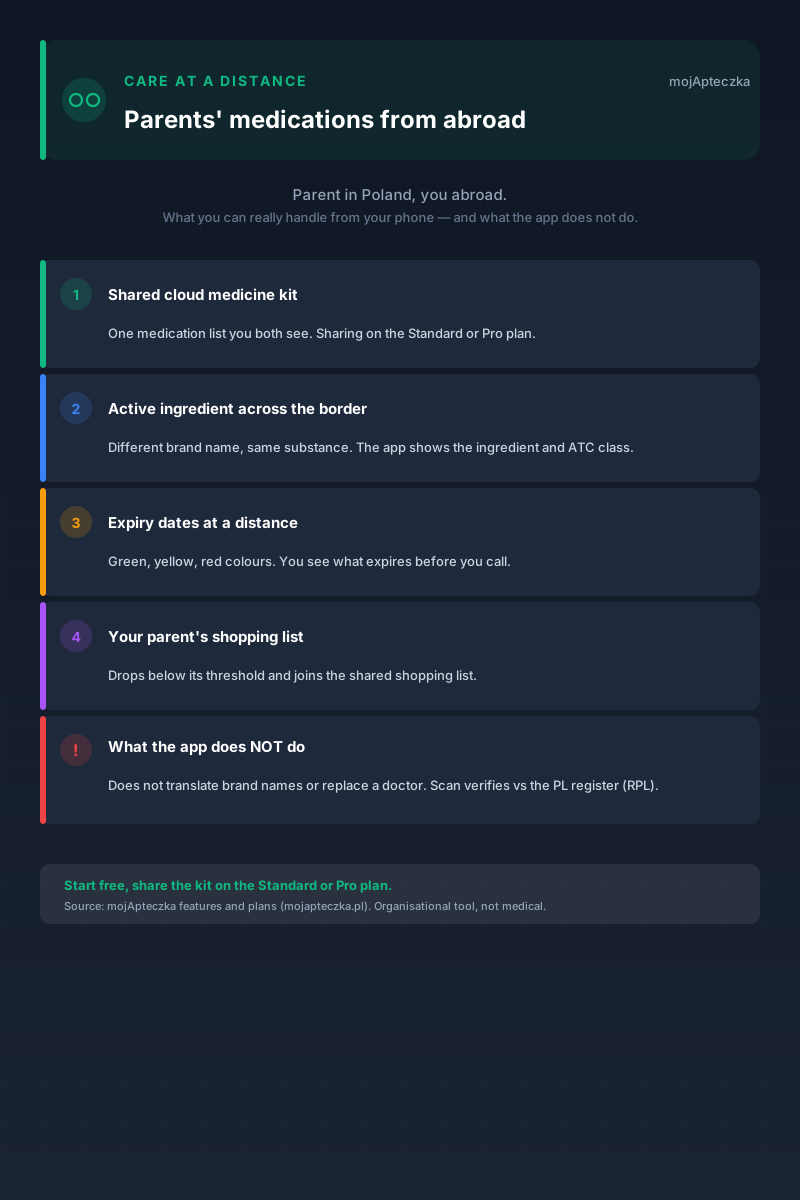
The starting point is a shared family medicine kit. Instead of two partial pictures — yours from a phone call and mum’s from memory — there is one list you both see. Medication names, the number of packs, expiry dates, and who each item belongs to. Your parent adds a medication on their end; you see it on yours after syncing. No more “check what I sent you on WhatsApp” — there is one current state.
This solves the first problem: you do not need to look in the drawer, because the drawer “reports in” on a list you carry in your phone in Amsterdam, London or Chicago. If your parent is on several medications at once, you can go a step further and assign each to a specific person’s profile. It is the same mechanism we describe in the piece on why a family medication tracker is worth it for any home.
Here is the part to say plainly, because it touches cost. The free plan supports one account and one kit. It is great for trying out scanning and tidying up your own medications, but not for running a shared kit between two of you. Sharing between people starts on the Standard plan (up to 5 people), and the Pro plan (up to 10 people) is built squarely for people managing the medications of several relatives. We say this openly so that nobody assumes sharing a kit across a border works for free.
The active ingredient is a common language across borders
The second problem — different brand names — calls for care, because it is easy to promise too much here. So let us say exactly what the app does and does not do.
What it does not do: it will not translate a Polish medication name into a brand sold in another country, and it will not tell you “what this is called abroad.” There is no such feature, and we do not pretend there is.
What it does: it shows the active ingredient and the ATC class. And that is more reliable than the brand name, because the active ingredient is international. Paracetamol is paracetamol whether the box reads one brand in Poland and another in Ireland. The substitutes finder groups the medications in your kit by exactly that — active ingredient and ATC class — showing that two differently named boxes are the same active substance. And recognising a medication from a photo reads the active ingredient off the pack, among other details, so it lands on the list automatically.
In practice it works like this: when your parent’s doctor in Poland, or the pharmacist in the country where you live, asks “what is he taking?”, you answer not with a brand the other person may not know, but with the active ingredient and the dose. That is information that crosses a border without translation. One important caveat: recognition and verification rely on the Polish Medicinal Product Registry, so for a medication bought abroad the match to the registry may not work. In that case the safest detail is the active ingredient copied straight off the box.
Expiry dates you cannot check in person
The third matter is something a glance into the cupboard settles in one city, and which becomes invisible at a distance: expiry dates. Expiry date alerts flag each medication with a colour — green means valid, yellow means it expires within 30 days, red means it is expired or runs out today. There is also a separate panel of expiring medications with a filter for 30, 60, 90 or 180 days.
For you, from another country, this means something concrete: you open the shared kit and see straight away whether mum’s heart medication is glowing red because its date has just passed. You do not have to ask her to “check the dates on every box,” which is tedious and easy to miss, especially for an older person with poorer eyesight. You have the state of the kit in front of you before you call. It changes the conversation: instead of “please check the dates,” you say “Mum, those drops expire in two weeks, I’ll add them to the shopping list.”
A shopping list at a distance — you know what your parent is short of
Speaking of the shopping list — that is the fourth piece of the puzzle. The low stock feature lets you set a refill threshold for each medication: the minimum number of packs below which the item lands on the shopping list. When the stock recorded in the app drops below the threshold, the medication appears on the list as “to buy”.
From the point of view of someone abroad, this changes one small but nagging thing. You know your parent is running out of a regular medication before the last pack is left, not on Sunday evening with the pharmacy shut. You can ask a neighbour, a sibling, or your parent in good time to top it up, or plan it for your next visit. The shopping list is shared, so everyone with access sees the same gaps — no duplicate purchases and no “I thought you were buying it.”
The caregiver role and showing the list to a local doctor
When you take on watching over a parent’s medications, a clear division of roles helps. The caregiver role lets you work on the kit assigned to the person you are helping — checking medications, records and expiry warnings. One note: this feature is available in the mobile app.
There is still the moment when your parent in Poland goes to their own doctor or pharmacist, and you are not there. Here sharing the medication list via a QR code helps: your parent shows the code, the other person scans it and sees the list of regularly taken medications without installing the app and without logging in. Instead of reciting from memory or shuffling bits of paper, they show the current list with active ingredients. If a more formal summary helps, the same set of data can also be prepared as a PDF report and you can share a medication list for a doctor’s visit.
And when a parent takes several medications at once — which is the rule among seniors — it is worth going through their list calmly once. That is where the subject of polypharmacy and managing multiple medications in a senior begins, and basic interactions can be checked in the free interaction checker. It is still information for a conversation with a pharmacist, not a substitute for that conversation — more on that in a moment, because it matters.
What the app does not do — plainly
At a distance, the temptation to have the app “solve” more than it can is greater, because you lack direct contact. So it is worth drawing the lines clearly:
- It does not translate brand names between countries. It shows the active ingredient and the ATC class, the common language, but it is you or the doctor who links that to a specific brand available in a given country.
- It does not replace your parent’s doctor or pharmacist. Treatment decisions — what to take, in what amount, and what to stop — belong to a specialist who knows your parent. The app is a layer of memory and order, not a medical decision system.
- The medication data is basic, not clinical. Medication details are enriched from the Polish medicines register (RPL), and interaction checking relies on the DDInter 2.0 database and is informational in nature.
- It needs an account and runs in the cloud. To share a kit across countries, the data has to sync. It is stored on AWS servers in the European Union, and only the people you invite can reach it.
This honesty is the heart of it, not a footnote. The greater the distance, the easier it is to hand the app decisions it should not be making. The app puts the facts in order; a person with medical knowledge assesses and treats.
Where to start: the first week
The start is the hardest part, because it asks the two of you to settle something. After that it is just checking the list. A practical order that works for families split by a border:
- Set up a shared kit and invite each other. Your parent can run it and you join, or the other way round — you set it up and invite your parent. What matters is that there is one list from the start, not two.
- Add the regular medications. Quickest is a photo of the pack — then the active ingredient, dose and expiry date land on the list automatically. Medications bought abroad are worth adding by hand, copying the active ingredient straight off the box.
- Set refill thresholds for the medications taken daily, so a dwindling supply shows up on the shopping list on its own.
- Go through the expiring panel once at the start and clear out anything past its date — after that a glance at the colours is enough.
- Agree on who is responsible for what: who buys in Poland, who watches the list from abroad, who talks to the parent’s doctor. The app gives a shared picture; people set the division of roles.
Five steps, one afternoon. From that moment your parent’s kit stops being a black box on the other side of the border.
From “I think so” to “I can see it”
Let us go back to Magda and her mum. Nothing we have described will let Magda look into a drawer in Poland from Amsterdam. But a shared list, expiry colours, a shopping list, and the active ingredient instead of an unfamiliar brand turn her “I think so” from the evening call into “I can see it.” And that is the whole difference between worrying at a distance and quiet, concrete support.
The simplest way to start is the free plan: tidy up a few of your own medications, try scanning, and see whether this kind of system suits you. When you decide to run a parent’s kit together across the border, reach for the Standard or Pro plan, where sharing is built squarely for families managing the medications of several relatives. For more on what it is like to look after someone’s medications at a distance, see the page for caregivers, and we write about the daily division of duties in the guide to the caregiver role in managing a family’s medications.
mojApteczka is an organisational and informational tool. It helps you put medications in order and share the list with loved ones, but it does not replace advice from a doctor, pharmacist or nurse. It does not translate brand names between countries and it does not make therapeutic decisions, which always belong to a specialist who knows your parent’s situation.
Frequently asked questions
- Can I manage my parent's medications from another country?
- Yes, if you set up a shared medicine kit. Your parent's medication list lives in the cloud, so you see it from another country exactly as they see it at home — medication names, the number of packs, expiry dates and what is running low. Sharing across several people needs a Standard or Pro plan; the free plan supports a single account, so it is good for trying the app out, not for running one kit together across a border.
- Will the app translate a Polish medication name into a foreign brand?
- No. mojApteczka does not turn the name "Apap" into the equivalent sold in Germany or Ireland, and it will not tell you what the same medication is called abroad. What it does show is more reliable than translating names — the active ingredient and the ATC class. The active ingredient (paracetamol, say) is the same the world over, whatever the brand name on the box. That, not the brand, is the common language when a doctor in one country asks about a medication bought in another.
- Can I scan a medication pack bought abroad?
- The scan reads what it can see in the photo: the name, the dose, the form and the expiry date. Recognised data is then verified against the Polish Medicinal Product Registry (RPL), so for a medication bought abroad the match to the registry may not work. The safest piece of information in that case is the active ingredient printed on the box — that is the one worth saving, because it makes the conversation with a doctor or pharmacist in Poland easier, without matching a substitute brand.
- Do my parent in Poland and I abroad see the same list live?
- Yes. A shared kit is one list for everyone with access — when your parent adds a new medication, or you flag that something is running low, the other side sees the same up-to-date contents after syncing. There are no two versions of the list and no "check the message for what I bought." Sharing with another person is available on the Standard plan (up to 5 people) or Pro plan (up to 10 people).
- Does it work for free?
- The free plan (up to 20 medications, one kit, one account) lets you try scanning, add your first medications and see whether this kind of system suits your family. Sharing a kit across borders itself starts on the Standard plan (9.99 zł/month, up to 5 people), and the Pro plan (19.99 zł/month, up to 10 people) is built squarely for people managing the medications of several relatives.
- Where is my parent's data stored and who can access it?
- Data is stored on AWS infrastructure inside the European Union (Frankfurt). Using the app requires a login (a Google or Facebook account, or email and password), and only people your parent or you invite can reach the kit. You decide who sees the list.
- How is this different from a travel kit and from caregiving within one country?
- A travel kit is about a single trip — what to pack and how to cross a border with medications. Remote care within one country assumes you can drop in now and then and look in the drawer. This article is about the permanent situation, where the border sits between you all year round. You will never check the kit in person, and your parent's medications and yours carry different brand names in different countries. That is a different problem from a one-off trip.