Polypharmacy: how to manage multiple medications safely in older adults
An older adult takes 5, 8 or even 12 medicines a day. How can you avoid interactions, mix-ups and risks? A practical guide for caregivers.
Marek is 58 and has been caring for his mother for two years. She recently turned 82. She takes eleven medicines a day: for high blood pressure, diabetes, cholesterol, osteoporosis, reflux, joint pain, insomnia, thyroid disease, anaemia, plus two supplements prescribed by different doctors. Marek keeps her home medicine cabinet in a plastic organiser with seven compartments for the days of the week. Every Sunday evening, he spends forty minutes setting out the tablets. And every time, he wonders whether he has missed something.
If you are in a similar situation, this article is for you. Managing multiple medications in an older person is not just a matter of organisation. It is a matter of safety.
What polypharmacy is
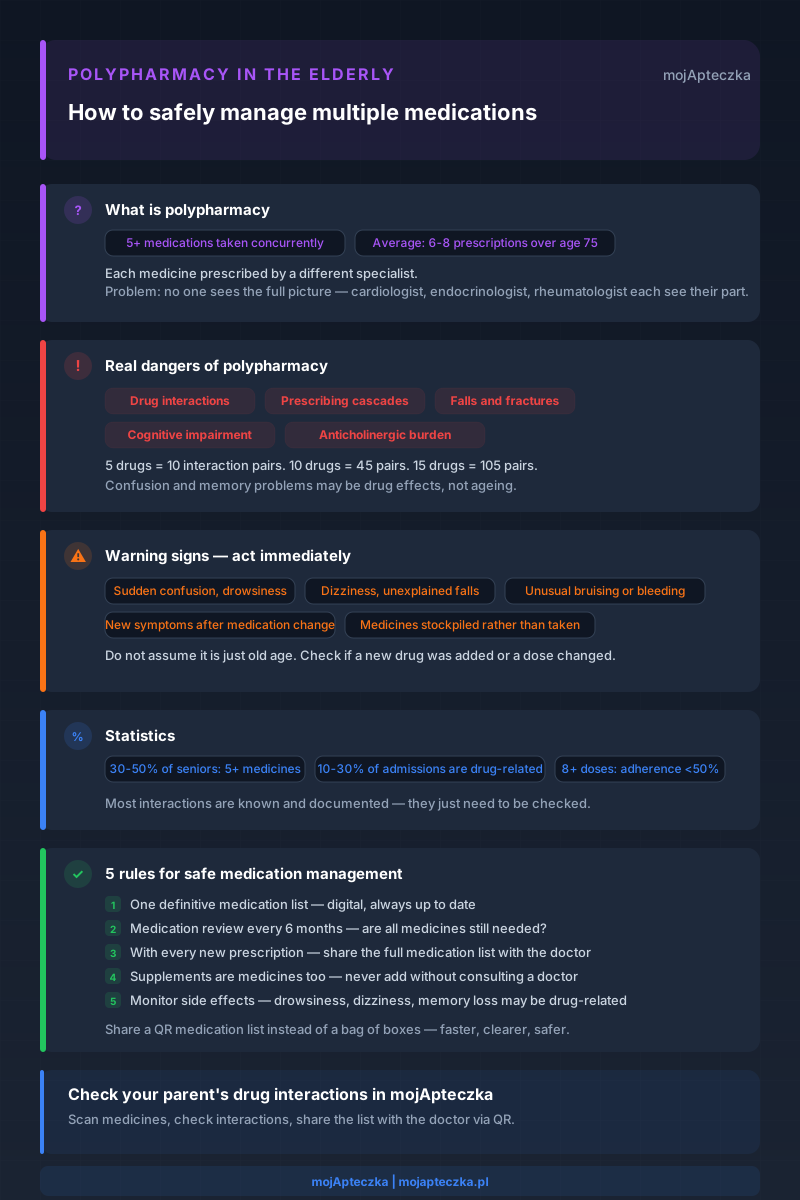
Polypharmacy is the medical term for taking many medicines at the same time. It is most often defined as starting at five medicines, although in practice many geriatricians start to see it as a problem only at eight or more preparations.
The statistics are telling. According to data from Statistics Poland, people over 75 in Poland take an average of six to eight prescription-only medicines, not counting supplements, vitamins and over-the-counter medicines bought without a prescription. Some older adults take twelve, fifteen or even twenty preparations a day.
The problem is not that these medicines are unnecessary. Each one was prescribed for a specific reason, by a specific specialist. The problem is that no one is looking at the whole picture.
The cardiologist prescribes heart medicines. The endocrinologist handles the thyroid. The rheumatologist treats the joints. The gastroenterologist looks after the stomach. Each person sees their own part of the picture. No one sees the stack of eleven boxes on the kitchen table.
Real risks — not theoretical ones
Polypharmacy is not an abstract problem from a pharmacology textbook. It is a concrete risk affecting real people.
Drug interactions. The more medicines there are, the more potential interactions there are. With five medicines, there are 10 possible interaction pairs. With ten medicines, there are 45 pairs. With fifteen, there are 105. Some of these interactions are mild; others can be dangerous. Warfarin, an anticoagulant, interacts with dozens of medicines and foods. Statins combined with certain macrolide antibiotics can lead to muscle damage. Medicines for high blood pressure may become less effective when taken with non-steroidal anti-inflammatory drugs.
The prescribing cascade. A doctor prescribes medicine A, which causes a side effect. The patient reports that side effect to another doctor, who interprets it as a new symptom and prescribes medicine B to treat it. Medicine B causes another side effect, and so on. This is not rare; it is part of everyday geriatric care in Poland.
Falls and fractures. Many medicines commonly used in older adults — benzodiazepines, sleeping tablets, opioids, some antidepressants and medicines for high blood pressure — increase the risk of falls. With polypharmacy, these effects accumulate. A hip fracture in an 82-year-old woman is not just a broken bone; it is often a life-changing event.
Cognitive problems. Some medicines have anticholinergic effects, which means they weaken acetylcholine signalling in the brain. Taken alone, their effect may be barely noticeable. But when an older adult takes three or four medicines with anticholinergic effects at the same time, the effect adds up and can appear as disorientation, memory problems or confusion. Symptoms that the family interprets as “ageing” or “the start of dementia” may be caused by medicines.
One coherent picture instead of eleven boxes
The basic problem in polypharmacy is fragmented information. Each doctor sees their own part, the pharmacist sees what they have dispensed, and the caregiver sees a pile of boxes.
The solution is to create one complete list of all the medicines, supplements and preparations the older person takes. Not on a piece of paper, because paper gets lost. Not in your head, because memory fails. Not across eleven different prescriptions, because no one gathers them in one place.
In mojApteczka, you can scan every medicine and build a complete picture of one person’s pharmacotherapy: in one place, on one screen. It is not just a list of names. It is a list with expiry dates, classifications, notes and, most importantly, the ability to check interactions.
Checking interactions — do not wait for a side effect
The most frustrating thing about drug interactions is that most of them are known and documented. No one needs to discover them again. The problem is that no one checks them in the context of a specific patient.
The drug interaction checker in mojApteczka lets you select medicines from the home medicine cabinet and check whether there are any known interactions between them. It does not replace a clinical pharmacist or doctor, but it gives you a starting point for a conversation.
Marek, the 58-year-old caregiver from the beginning of this article, could check his mother’s eleven medicines in a few minutes and see which pairs need attention. Then he could take that list to the GP and say: “Here are all the medicines Mum takes. These three pairs have potential interactions. Should we change anything?”
That changes the dynamics of the appointment. Instead of a doctor with fifteen minutes who does not know what the rheumatologist prescribed, you have a caregiver who arrives with the full picture.
The caregiver’s role — you do not have to be alone
If you care for an older parent or loved one, you know how lonely that role can be. You organise medicines, keep track of appointments, call pharmacies and try to understand prescriptions written in illegible handwriting. And often, you do it alone.
mojApteczka has a caregiver role feature that lets you manage the home medicine cabinet of the person you care for from your own phone. You do not have to log in to your mother’s account or ask her for her password. You have your own account, with a separate home medicine cabinet for the person in your care.
This matters especially when you care for someone who cannot manage their medicines on their own, whether because of dementia, limited hand function, sight problems or simply feeling overwhelmed by the number of medicines.
Sharing with a doctor — QR instead of a plastic bag
You know the scene: an older person comes to the doctor with a carrier bag full of medicine boxes, empties them onto the desk and says, “I take all of this.” The doctor sorts, reads and tries to work out what is prescription-only, what is OTC and what is a supplement from a daughter in Germany.
There is a simpler solution. In mojApteczka, you can share the medicine list via QR code. The doctor scans the code with a phone and sees a complete, clear list: medicine name, dose, quantity and expiry date. No carrier bag, no sorting, no guessing.
This also works in emergencies. If the person you care for ends up in an emergency department and cannot say which medicines they take, a QR code on a phone, yours or theirs, gives the paramedic immediate access to the information.
5 practical tips for caregivers
1. Keep one complete medicine list. Not three pieces of paper, not “what I remember”, not “prescriptions in the drawer”. One list, kept up to date. Digital, so it does not get lost.
2. Review medicines with a doctor once a quarter. Do not wait until something happens. Book an appointment dedicated only to reviewing medicines. Bring the full list. Ask: “Are all these medicines still needed? Can any of them be stopped?”
3. Ask about interactions with every new medicine. When a specialist prescribes a new medicine, tell them which medicines the person you care for already takes. Do not assume the doctor knows. If they are not the GP, they probably do not.
4. Do not add supplements without consultation. Vitamin D, magnesium, omega-3, curcumin: these are not “just vitamins”. Supplements interact with medicines. Magnesium reduces the absorption of some antibiotics. St John’s wort reduces the effectiveness of dozens of medicines, including anticoagulants. Grapefruit, yes, grapefruit, affects the metabolism of statins.
5. Monitor side effects, not just disease symptoms. If the person you care for has become sleepier, more confused, dizzy or unsteady, do not assume it is “old age”. Check whether they recently started a new medicine. Check whether the dose has changed. Side effects in older adults are often subtle and slow to appear, so they are easy to miss.
It is not about perfection. It is about having a system
No one expects you to become a pharmacist. But as a caregiver, you can create a system that minimises the risk of mistakes. One source of truth about the medicines taken by the person you care for. Regular reviews. Interaction checks. Communication with the doctor based on data, not memory.
Marek from the beginning of this article does not have to spend Sunday evenings worrying that he has made a mistake. He needs a tool that gathers all the information in one place and helps him ask the right questions.
If you are in a similar situation, try mojApteczka. Scan the medicines of the person you care for, check interactions and share the list with the doctor. It does not take long, and it can change a great deal. The Android app is also available on Google Play.
Listen to the podcast: Episode 5 — “Seven boxes in a plastic bag” — on polypharmacy in older adults, the prescribing cascade, and how one medicine list with active substances replaces a plastic bag full of boxes.
Have questions or suggestions? Write to us at: kontakt@mojapteczka.pl