Travel Medicine Kit — What to Pack When Travelling Abroad
A complete medicine checklist for travelling abroad. Customs rules, OTC and prescription-only medicines, and how to share your medicine list with a doctor abroad.
You are packing your suitcase for a holiday. Passport, charger, power adapter. And your medicines? “I will buy them locally if I need them.” That is the point at which many travellers make a mistake that can cost them dearly — literally and figuratively.
Abroad, you cannot buy prescription-only medicines without a local prescription. You may not find ibuprofen under the brand name you recognise. The pharmacy may be closed at the weekend. And if you fall ill in a small town in Sicily or on a Greek island, the nearest medical facility may be an hour’s drive away.
A well-prepared travel medicine kit is not excessive caution — it is a basic part of preparation that takes 15 minutes and can save your holiday.
Why a travel medicine kit matters more than you think
At home, when you feel unwell, you open your medicine cabinet. On holiday, you do not have that cabinet. And the need for a medicine usually appears at the worst possible moment — at night, at the weekend, far from a pharmacy.
The most common medical situations on holiday are:
- Headache and fever — travel fatigue, air conditioning, a change of time zone.
- Stomach problems — new food, water, a change in diet. Travellers’ diarrhoea affects 30-50% of tourists visiting developing countries.
- Cuts and grazes — active holidays, sand, coral, stones.
- Allergic reactions — new allergens, insect bites, reactions to the sun.
- Colds — air conditioning running at full blast.
Each of these situations may require a medicine you do not have to hand. And buying medicines abroad can be complicated — especially outside Europe.
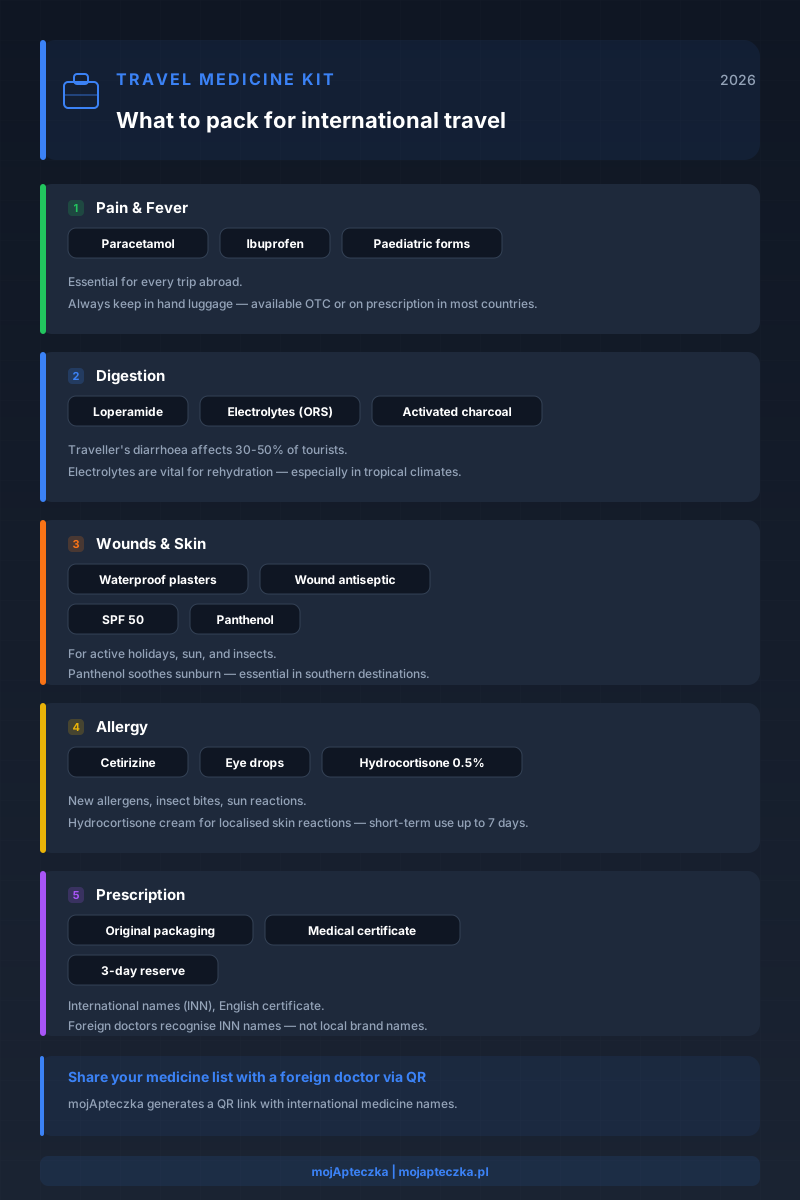
Medicine checklist for international travel
Pain relief and fever reduction
- Paracetamol — a universal painkiller and fever reducer. Safe for most people.
- Ibuprofen — for pain, fever, and inflammation. Do not take it on an empty stomach.
- Paediatric versions (syrup, suppositories) — if you are travelling with children.
Digestive system
- Loperamide (Imodium) — for diarrhoea. The first medicine many people reach for with travellers’ diarrhoea.
- Oral rehydration salts (ORS) — sachets to dissolve in water. Essential for dehydration, especially in children.
- Activated charcoal — for food poisoning.
- Heartburn medicine — if you are prone to stomach problems.
Wound care and skin protection
- Waterproof plasters — in different sizes.
- Antiseptic solution or spray — octenidine-based products or povidone-iodine pen for wound disinfection.
- Elastic bandage — for sprains, strains, and compression.
- Sunscreen — SPF 50 for the face, SPF 30 for the body.
- Sunburn cream — with panthenol.
- Insect repellent — with DEET or icaridin.
- Gel for bites — dimetindene (Fenistil) for itching after bites.
Allergy management
- Oral antihistamine — cetirizine or loratadine.
- Eye drops — for allergic conjunctivitis.
- Hydrocortisone 0.5% — cream for local allergic reactions.
Prescription medicines
- All medicines you take regularly — in their original packaging with a label.
- Medical certificate — a list of medicines with international names (INN), dosage, and diagnosis. Ideally in English.
- Supply for the full trip plus 3 days — in case your return is delayed.
Additional items
- Digital thermometer — small and travel-sized.
- Nail scissors or tweezers — in checked luggage.
- Hand sanitiser — antibacterial gel.
Customs regulations — what you can and cannot carry
Regulations vary between countries, but the general rules are:
Within the EU/EEA: Free movement of medicines for personal use applies. A Polish prescription is theoretically recognised across the EU, but in practice not every pharmacy will honour it. Medicines containing controlled substances require a Schengen certificate — a form available from your doctor.
Outside the EU: Most countries allow OTC medicines to be carried without restrictions. Prescription-only medicines require a medical certificate. Some countries (such as Japan, the United Arab Emirates, and Singapore) have very strict rules on controlled substances — even codeine may be prohibited.
General rules to follow:
- Carry medicines in their original packaging with a readable label.
- Have a medical certificate for prescription-only medicines.
- Check the regulations of your destination country before departure.
- Liquid medicines in hand luggage — the 100 ml per container rule applies in aviation.
How to share your medicine list with a doctor abroad
Picture this situation: you are on holiday in Spain, you feel unwell, and you go to a doctor. The doctor asks what medicines you take regularly. You try to translate the medicine names from Polish into Spanish, but you cannot — because brand names differ in every country.
In mojApteczka you can generate a QR link containing your medicine list and share it with a doctor abroad. The list includes international names of active ingredients (INN), dosages, and expiry dates. The doctor scans the code with their phone and sees the full list — without a language barrier.
This is particularly valuable if:
- You take several medicines regularly (for hypertension, diabetes, thyroid disease).
- You are travelling with children who have prescribed medicines.
- You care for an older parent who is travelling with you.
Pre-departure checklist
Before every trip abroad, check:
- Prescription-only medicine supply — for the whole trip plus a 3-day buffer.
- Medical certificate — with a list of medicines in English.
- Expiry dates — scan your medicines in mojApteczka and check whether anything expires during your trip. The expiry date alert feature will show you this in seconds.
- OTC travel kit — paracetamol, ibuprofen, loperamide, electrolytes, plasters, antiseptic, SPF.
- Health insurance — EHIC card (in the EU) or travel insurance.
- Customs regulations — check whether your medicines are allowed in your destination country.
You do not need to build this list from scratch. If you have your medicines in mojApteczka, you open the app and see what you have, what is still in date, and what is missing — before you even set off. The Android app is also available on Google Play.
Medical disclaimer: This article is provided for informational and educational purposes only. It does not constitute medical advice and is not a substitute for consultation with a doctor or pharmacist. Regulations governing the transport of medicines vary between countries — always verify current rules before travelling.
Have questions or suggestions? Contact us at: kontakt@mojapteczka.pl
Frequently asked questions
- What medicines can I take through customs?
- OTC medicines can be carried without restrictions in quantities for personal use. Prescription-only medicines require a prescription or medical certificate — ideally in English. Controlled substances (opioid painkillers, benzodiazepines) are subject to additional regulations — check the destination country's rules before travelling.
- How many medicines can I take in hand luggage on a plane?
- Solid medicines (tablets, capsules) can be carried in hand luggage without quantity limits. Liquid medicines (syrups, drops) are subject to the 100 ml per container rule in a clear bag. Exceptions apply to medicines needed during the flight — in that case, it is worth carrying a medical certificate.
- Can I buy medicines abroad without a Polish prescription?
- It depends on the country and the medicine. In EU countries, mutual recognition of prescriptions applies, but in practice not all pharmacies honour them. Outside the EU, Polish prescriptions are not recognised. OTC medicines can be bought everywhere, but brand names differ between countries — so it is worth knowing the active ingredient names.
- How can I share my medicine list with a doctor abroad?
- In mojApteczka you can generate a QR link with your medicine list and share it with a doctor abroad. The list includes international names of active ingredients, which makes communication easier regardless of language.