School medicine kit 2026: what to pack
What goes in a school medicine kit, what to agree with the school, and how to keep an eye on expiry dates. A practical, no-nonsense checklist for parents.
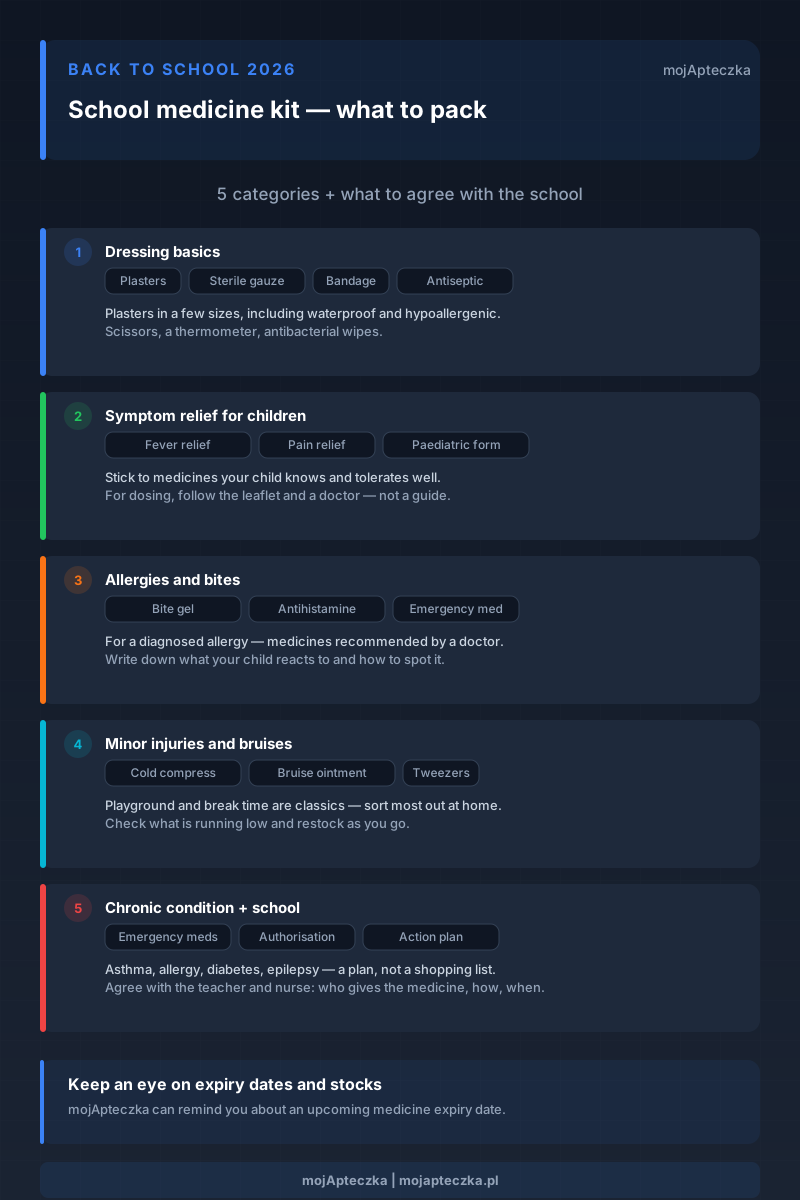
First bell, new backpack, book list ticked off. Then the phone rings from school: your child has grazed a knee at break, or has come home with a fever that flared up over a few hours. September is not just about the new-term shopping. It is also the point when the home medicine cabinet starts working overtime again — more contact with other kids means more infections, scrapes and minor injuries.
A well-prepared school medicine kit does not mean a box stuffed with medicines “just in case”. It is a considered, current set that covers the situations you actually run into with a school-age child, and saves you hunting for an open pharmacy at some unholy hour. Below you will find a concrete list, a split between what stays at home and what your child carries, and the easy-to-forget parts: what to agree with the school and how to stay on top of expiry dates.
What a school medicine kit is, and how it differs from the home one
“School medicine kit” actually covers two different things, and it helps to keep them apart.
The first is the mandatory first aid kit on the school premises — equipment the school is responsible for. The second, the one this guide is about, you put together as a parent: a set tailored to your child. Some of it stays at home and comes back into play when your child turns up with an infection. Some of it, with a chronic condition, your child may carry or leave with the nurse.
What sets it apart from a classic home cabinet is where the weight sits. A home cabinet serves the whole household and every generation. A school kit is narrower and more child-focused: it leans on paediatric forms, the minor injuries of breaktime and the playground, and what realistically happens over a school year. If you are building everything from scratch, start with the broader complete guide to the home medicine cabinet, then pull the school portion out of it.
What should be in a school medicine kit? A list by category
The simplest way to think about it is in categories, not individual packets. Five groups cover the vast majority of situations, and there is an upside to framing it this way: instead of buying “one more thing because it happened to be at the pharmacy”, you fill a specific gap. The kit stops swelling year on year, and it stays manageable.
Dressing basics
This is the core you will reach for most often — for grazes, cuts and small wounds:
- plasters in a few sizes (including waterproof and hypoallergenic),
- sterile gauze and compresses,
- an elastic bandage and surgical tape,
- a wound antiseptic,
- antibacterial wipes (handy away from home too),
- scissors and a thermometer.
Symptom relief in a child-friendly form
For school-age infections, fever and pain relief in a paediatric version can help. Stick to the medicines your child knows and tolerates well. This guide does not provide dosing information — for how to use a specific medicine, follow the leaflet, the prescription and the advice of a doctor or pharmacist. There is more on the organisational side in the piece on how to give medicines to a child safely.
Allergies and bites
September is still insect and pollen season, and school means a lot of time outdoors:
- something soothing for bites (a gel or a cooling stick),
- if your child has a diagnosed allergy — the antihistamines a doctor has recommended,
- with an allergy that carries a risk of a severe reaction — emergency medicines exactly as the specialist instructed, plus a clear plan for who gives them and how.
If your child has a food allergy, one more item joins the kit that is not a medicine: a current, written note of what they cannot eat and how to spot a reaction. At school, where meals are often shared and several people are in charge, a note that leaves no doubt can matter more than the product itself in the backpack.
Minor injuries and bruises
Playground, stairs, break time — bruises and grazes are the classics of the school years. A cold compress helps (a gel pack from the freezer, or a single-use one you activate by squeezing), along with a bruise ointment and a cooling spray or plaster. Tweezers for a splinter and a few disposable gloves are worth having too.
You sort out most of these at home after school, so there is no point packing this whole category into the backpack. It is enough to have it assembled and within reach — and when something starts running low, it is easier to catch if an app flags low stock than if you discover an empty shelf at the very moment you need it.
A child with a chronic condition
Asthma, an allergy with a risk of a severe reaction, diabetes, epilepsy — here the school kit stops being a shopping list and becomes a plan. Emergency medicines have to be available and current, and the rules for giving them agreed in advance. I come back to this below, because the question is no longer just what to pack, but who acts and how.
Where to keep what: home, backpack, school
Not everything travels with your child. A sensible split looks like this:
- At home stays the main cabinet — symptom medicines, a stock of dressings, a thermometer. This is what you use when your child is ill and off school.
- In the backpack your child carries a minimum: a few plasters, wipes, and anything a doctor recommends. The younger the pupil, the fewer loose medicines in the bag.
- At school — only what the chronic condition calls for and what has been agreed with the school (for example an inhaler, or emergency medicines kept with the nurse or in a designated place).
One thing does not change: keep medicines out of reach of younger children and away from damp and heat. How to set that up at home is covered in a separate piece on keeping medicines safe at home with children.
Medicines at school — what to agree with the teacher and nurse
This is the part parents most often skip, and the one that matters most for a child with a chronic condition.
Start with a conversation at the beginning of the year. Do not assume a teacher will be able to, or will have to, give a medicine — the rules depend on the school’s procedure, the consents and documents collected, and whether staff are available. So do not count on “someone giving it when needed”. With a chronic condition, giving a medicine can usually be arranged, but it takes agreement: most often a parent’s written authorisation, the written consent of the person who is to give it, a clear instruction, and a note of where the medicine is kept. The scope and form depend on the specific school and on whether it has a nurse.
Check, too, whether and when a nurse is on site at your school — not everywhere has one every day. The sooner you know, the better you can plan who understands your child’s situation when the nurse is away. If your child takes a medicine at a fixed time, work out whether that falls during lessons, after-school club or extra activities — and who is keeping an eye on it then.
A practical list to settle:
- who at school knows about your child’s condition and medicines,
- where the medicine is kept and who can access it,
- exactly what to do in an emergency and who to notify,
- which documents (authorisation, consent, doctor’s recommendation) you need to provide,
- how long the medicine is in date and when to replace it.
The more concretely you write this down, the less improvising under stress. And to keep the whole family and the school looking at the same current information, one shared medicine list beats notes scattered in several places.
How not to lose track of dates and stocks
A school kit has one weak point: you put it together once, in September, and then forget about it — until you find a plaster peeling off and a syrup past its date. A simple system on your phone helps here.
mojApteczka is an app that puts the home medicine cabinet in order: you scan a packet with your phone, the app recognises the medicine and suggests the basic details. In the context of a school kit, four things are the most useful:
- Expiry alerts — the app can remind you about an expiry date that is coming up, if the medicine and date are added and notifications are working, so it is less likely to surface only at the moment the medicine is needed.
- Paediatric classification — helps you see which products at home are marked as suitable for children when you are assembling the “child” portion.
- Low stock — flags what is starting to run out, so you can buy it before the first bell rather than mid-infection.
- Shared medicine cabinet — parents, a grandparent or a carer see the same current list of the child’s medicines, which makes school pickups and taking turns easier.
Let me be plain about where the line is. mojApteczka is an organisational and informational tool — it helps you stay on top of what you have, when it expires and who can see it. Medicine information (including basic interactions from the DDInter 2.0 database) is there for informational support, not diagnosis. The app does not replace a doctor or pharmacist and does not calculate doses — that is what the leaflet, the prescription and a specialist’s advice are for.
On the free plan you run one medicine cabinet with a list of up to 20 medicines in total and do 3 AI scans a month — for the school portion alone that is usually enough. Adding medicines by hand has no limit.
How to store and label your child’s medicines
The contents are only half the job — the other half is the order that stops anyone mixing things up in a hurry.
Medicines are best kept in their original packaging, together with the leaflet. It is not only about the expiry date printed on the blister — the leaflet can be needed when someone other than you takes over. If your child carries an emergency medicine, it is worth labelling the packaging clearly with their name and a short note on when and how to use it.
With a chronic condition, a simple information card helps: what your child has, which medicines they take, what they are allergic to and who to notify if needed. One current document the school can access works better than knowledge spread across several people’s memories. You can keep your child’s medicine list digitally and share it with the people who actually care for them — then every change (a new medicine, a different time, a stopped one) is visible at once, with no updating of notes in several places.
Avoid decanting medicines into unlabelled containers and “weekly” organisers for a child who cannot manage that on their own. For a pupil, clarity is what counts: it is obvious what the medicine is, who it is for and when it expires.
What a school medicine kit should NOT contain
A few things are better left out on purpose:
- prescription medicines “borrowed” from a family member — a medicine chosen for a sibling or parent is not for this child,
- antibiotics “in reserve” — these are used only on a current doctor’s recommendation,
- expired products — instead of keeping them “in case”, hand them back to a pharmacy,
- too many symptom medicines at once — a bigger stockpile means a bigger chance of a mix-up and a missed date.
Less, but current and sensible, works better than an overflowing box where you cannot find anything in time anyway. If you are building the kit around the child specifically, the piece on medicines for children and their safety and the overview of what to buy and what you already have at home will help.
A quick September cheat sheet
- Separate two things: the school’s kit (their job) and your child’s kit (yours).
- Assemble the five categories: dressings, symptom medicines, allergies and bites, minor injuries, chronic needs.
- Split the contents: main medicines at home, a minimum in the backpack, only agreed medicines at school.
- With a chronic condition, agree with the school who gives the medicine and how — in writing.
- Keep an eye on expiry dates and stocks, ideally with reminders rather than memory.
A school medicine kit does not have to be big. It has to be current and considered — so that on the day you really need it, everything is in place and in date.
This article is informational and organisational in nature. It does not replace the advice of a doctor or pharmacist. For choosing medicines, dosing and how to handle a chronic condition, consult a specialist and follow the leaflet and the school’s guidance.
Frequently asked questions
- What should a school medicine kit for a child contain?
- The core is dressings (plasters in a few sizes, sterile gauze, a bandage), a wound antiseptic, antibacterial wipes and a thermometer. The rest you choose to fit your specific child — fever and pain relief in a paediatric form, something for insect bites, and, if your child has an allergy or asthma, the emergency medicines a doctor has prescribed.
- Can my child keep medicines in their backpack or at school?
- It depends on the child's age, the type of medicine and the rules of the specific school. Emergency medicines may need to be quickly accessible in line with a doctor's instructions, but how they are stored and given has to be agreed in advance with the form teacher and the school nurse. Do not assume — ask at the start of the year.
- Can a teacher give my child a medicine?
- Do not assume a teacher will be able to give a medicine — the rules depend on the school's procedure, the consents and documents collected, and whether staff are available. With a chronic condition it can usually be arranged, most often on the basis of a parent's written authorisation and the written consent of the person giving the medicine, sometimes with a nurse involved. Settle the details with the school individually before term starts.
- Which fever medicines should I keep for a schoolchild?
- Stick to the paediatric products your child knows and tolerates well. This guide does not provide dosing information — for how to use a medicine, follow the leaflet, the prescription and the advice of a doctor or pharmacist. mojApteczka helps you remember what you have at home and whether it is still in date, but it does not replace advice and does not calculate doses.
- How often should I check expiry dates in a school medicine kit?
- The easiest rhythm is once at the start of the school year and then every few months. It is easier to remember when an app can remind you about an expiry date that is coming up — provided the medicine and date are added and notifications are working — instead of relying only on checking the packets by hand.
- How is a school medicine kit different from the mandatory first aid kit at school?
- They are two different things. The mandatory first aid kit on the premises is the school's equipment. The school medicine kit in this article is the set you, as a parent, put together for your own child — at home, and where needed what the child carries with them.
- How do I keep track of my child's medicines when a grandparent picks them up?
- Shared access to the medicine list helps. In a shared medicine cabinet, a grandparent or carer sees the same up-to-date list of medicines and the organisational notes you share, with no scribbled scraps of paper or rushed phone calls.