Storing Medicines in Hot Weather: A Summer Guide
Heat in a car, a beach bag or on a windowsill can damage your medicines. Learn how to store your medicine cabinet in summer and which types are most at risk.
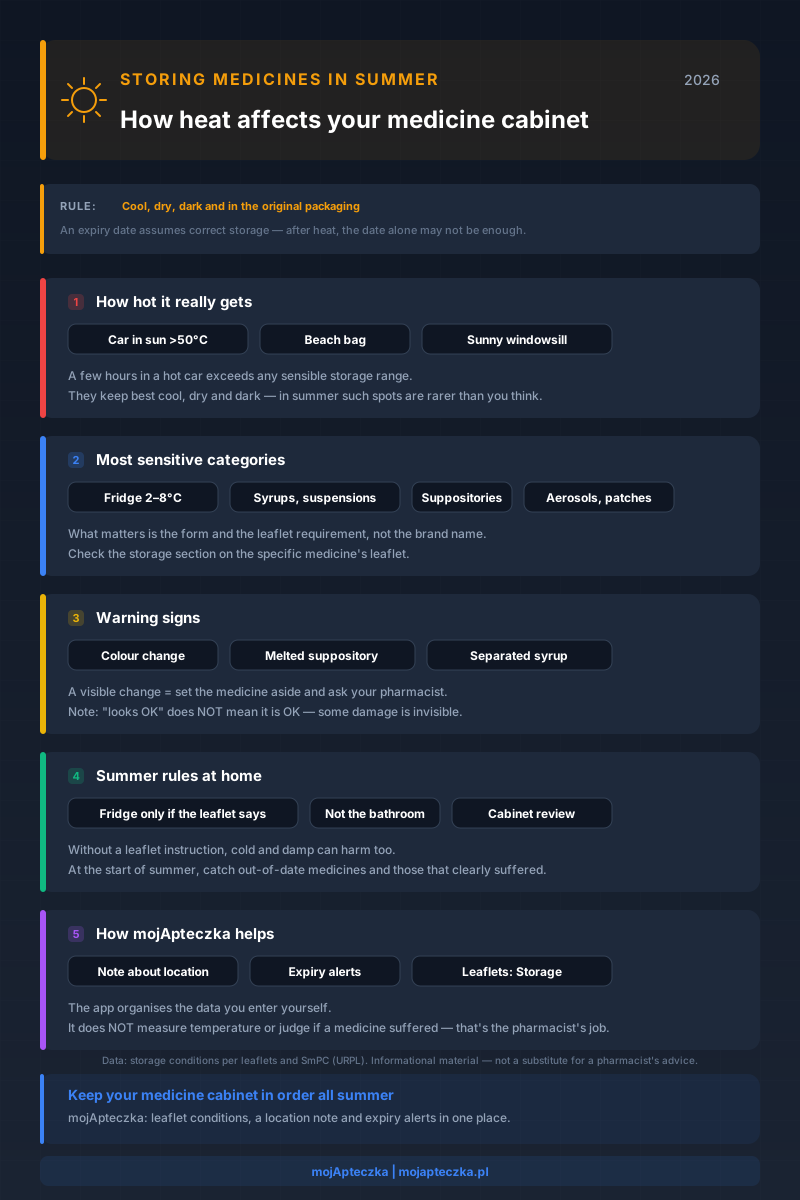
You grab the paracetamol from the glovebox after a whole day parked in full sun. The box is warm, the blister a little soft. Will it still work, or not? And what about the medicine syrup for your child that sat on the kitchen windowsill for a week? In summer, your medicine cabinet faces a problem we rarely think about the rest of the year: heat.
This isn’t scaremongering. The manufacturer prints storage conditions on the leaflet for a reason. Cross them and a medicine doesn’t suddenly turn into poison, but it can simply stop working the way it should. And that’s the part you can’t see from the outside. This guide explains how heat affects medicines, which categories are the most sensitive, and how to organise your home medicine cabinet through the summer months. It’s an informational, organisational piece: you won’t find dosing here, or a verdict on whether a specific medicine is still fit to use. The leaflet and your pharmacist are there for that.
Why heat harms medicines
On most boxes and leaflets you’ll find a line along the lines of “store below 25°C” or “store at 2–8°C”. That’s not a suggestion. It’s the condition under which the manufacturer tested the medicine’s stability. The active ingredient, together with the rest of the formulation, keeps its stated quality only as long as it’s held within those limits.
Heat speeds up chemical breakdown. The warmer it gets, the faster the reactions that use up the active ingredient and change the form of the medicine. For some products that means a gradual loss of effectiveness well before the expiry date printed on the box. Put another way: an expiry date assumes correct storage. If a medicine has spent a week in a baking-hot bag, the date on the box is no longer reliable.
It helps to separate two things people often mix up. The expiry date is the manufacturer’s promise, and it holds only if the medicine is stored correctly. The storage conditions are how you keep your side of that promise. We cover the markings on the packaging itself, including the EXP and LOT codes, in our guide to the markings on medicine packaging.
How hot it really gets in summer
The trouble with heat is that we underestimate the scale of it. A few of the spots where medicines most often end up in summer can catch you out:
- A closed car. This is the worst place for medicines you own, even though it isn’t the house. On a hot day the inside of a car parked in the sun can climb well above 50°C, and the glovebox or the shelf under the rear window higher still. A few hours is enough to blow past any sensible storage range.
- A beach bag in the sun. A dark bag lying in the sand works like a small oven. Medicines tucked in “just in case” next to the towels spend the whole afternoon in there.
- Windowsills and kitchen shelves above the hob. A south-facing windowsill can stay hot for most of the day, and above the hob you also get steam and heat from cooking.
- The trip home from the pharmacy. The journey back in the heat, with medicines dropped into a carrier bag and left in the car “for a minute”, is an easy one to forget.
The common thread is simple: medicines are happiest somewhere cool, dry and dark. In summer there are fewer such places at home than you’d think.
Which categories of medicine are most sensitive to heat
Instead of memorising a list of brand names, look at the form of the medicine and the storage requirement on the leaflet. Those are what decide how sensitive it is to temperature. The ones that most often need attention:
- Medicines that must be refrigerated (usually 2–8°C). If the leaflet gives a narrow, low temperature range, the medicine is sensitive by design and may lose its properties faster outside the fridge. This is the most urgent category in summer.
- Syrups and suspensions. Liquid forms can be especially fragile once opened, and heat encourages both separation and the growth of micro-organisms. Many of them also have a shorter shelf life after opening, stated on the leaflet.
- Suppositories and pessaries. They’re designed to melt at body temperature, so in the heat they can change form while still in the packet.
- Aerosols, sprays and pressurised inhalers. Pressurised canisters cope badly with overheating, which the label usually warns about.
- Patches, gels and creams. The carrier for the active ingredient can separate or change consistency, which affects how the medicine is released.
This isn’t a complete list, and it doesn’t replace the leaflet. Every medicine has its own specific instructions, and the surest source is the storage section of its documentation. In the mojApteczka app you’ll find the storage conditions on the medicine’s card: the leaflets and summaries of product characteristics have their own “Storage” section. If you’re unsure about a particular product, ask your pharmacist.
Real summer scenarios
Theory is one thing; in summer it’s the everyday situations that count. A few of the most common ones, and what you can do about them:
A car trip. Don’t keep medicines in the glovebox or under the rear window. Carry them in a cool bag with an ice pack, placed in the shade inside the cabin rather than in the boot. Once you arrive, move them somewhere cool straight away instead of leaving them in a hot car in the car park.
The beach and the pool. Take only what you genuinely need on the spot. Leave the rest in a cool room. Anything that has to travel with you should go in an insulated bag, away from direct sun and hot sand.
The summer house and the allotment. Places used only seasonally can be hot and damp, and medicines may have been sitting there since last summer. When you arrive, go through the cabinet: check the expiry dates, and set aside anything visibly changed or left in the heat for a long time, then ask a pharmacist.
Coming home from the pharmacy in the heat. Plan to buy any medicines that need refrigeration at the end of your route, so they spend as little time as possible in the warmth. On a really hot day, ask the pharmacy for an ice pack or bring your own cool bag.
A heatwave indoors. When the whole flat sits well above 25°C for days on end, simply keeping medicines in a cupboard may not be enough. Find the coolest spot in the home and move them there: the lowest shelf of a cupboard, away from south-facing windows, the hob and anything that gives off heat. Drawing the curtains during the day and leaving the cupboard door slightly ajar both help keep the temperature down. Don’t move everything into the fridge just to be safe, though. Without a clear instruction on the leaflet, cold and damp can be harmful too. If you do have a medicine that needs refrigeration, make sure the fridge runs steadily and keep the medicine on a shelf rather than in the door, where the temperature swings every time it’s opened.
Travelling by plane or train. In the heat, medicines are best carried on you rather than in checked luggage, which can spend long hours on hot tarmac or in an unmonitored hold. In your hand luggage you stay in control and avoid the temperature extremes. Pack anything that needs cooling in an insulated bag with an ice pack, but so that it doesn’t touch the pack directly and freeze. On a train without air conditioning the compartment can heat up badly too, so keep medicines in the shade, away from a sunlit window. Exactly what to take and how to pack it, we cover in the rules for carrying medicines in hand luggage and in our guide to a travel medicine kit for going abroad.
How to tell whether a medicine may have suffered
One simple rule applies here, and it works in one direction only. A visible change is a signal to set the medicine aside. A suppository that melted and set again, a tablet that has changed colour or crumbled, a syrup that has separated, a cream that has split, a swollen blister, tablets stuck together. In cases like these, don’t improvise: put the medicine aside and ask your pharmacist what to do next.
The rule doesn’t work the other way round, though. The fact that a medicine looks fine doesn’t mean it is fine. A loss of effectiveness after overheating often leaves no visible trace at all. So if you know a medicine has spent long hours in a hot car or in the sun, its appearance is a poor guide. Take those circumstances seriously and check with a pharmacist rather than trusting your own judgement. If sudden, serious symptoms appear after taking a medicine, call 112; in other cases, contact a doctor or pharmacist.
Summer storage rules at home
A few habits for the season:
- Cool, dry, dark and in the original packaging. The box and leaflet protect the medicine from light and moisture and tell you how to store it. Don’t decant medicines into containers of your own.
- The bathroom is a bad idea all year, and especially in summer. The steam and temperature swings around bathing make it one of the worst spots in the house. We go into this in more detail in our piece on ten medicines you store wrong.
- The fridge only when the leaflet says so. Without that instruction, cold and damp can do harm. And if it is the fridge, then a shelf, not the door or the area near the freezer compartment.
- A cabinet review at the start of summer. A good moment to catch medicines that are out of date and the ones that have clearly suffered. We’ve gathered the general rules in our guide to storing medicines at home, and for what to do with anything for disposal, see what to do with expired medicines.
If you’re only now putting together a kit for a holiday, you’ll find a practical list in our summer medicine kit guide.
How mojApteczka helps you organise your medicine cabinet in summer
The app won’t replace common sense or a pharmacist, but it does make it easier to stay on top of your medicine cabinet when there are a lot of medicines and you keep them in several places. Everything happens on your terms: you enter the details, and the app helps you order them.
- Storage conditions at hand. On the medicine’s card you have access to the leaflets and summaries of product characteristics, including the storage section. Instead of searching the internet for guidance, you check it right there on the specific product.
- A note about where it’s kept. In notes you can record, for example, that you keep a particular medicine in the fridge, or that it went with you to the summer house. It’s organisational information that helps everyone at home stick to a single version.
- Tracking expiry dates. Expiry alerts use colour to flag medicines that will soon expire and gather them in one panel. The alerts watch the date on the box, so in summer it’s worth doing this kind of review regularly and, while you’re at it, checking that medicines aren’t sitting somewhere too warm.
- Order by location. With medicine grouping you can arrange your cabinet the way you actually keep it at home: fridge medicines in one group, cupboard medicines in another, say. That makes it quicker to compare what’s in the app with what’s really on the shelf.
If you also manage medicines for your parents or older relatives, the shared cabinet view described on the for caregivers page may come in handy.
What the app won’t do
In all honesty: mojApteczka does not measure temperature and has no idea where your medicine physically sits. It won’t detect that a box spent a day in a hot car, and it won’t judge whether a medicine is still usable after overheating. It isn’t a sensor or a medical adviser. It’s an organisational tool that stores the information you enter and helps you find it quickly.
The decision on whether a specific medicine is still safe and effective belongs to a pharmacist or doctor. The app helps you keep track of what you have, when it expires and where you keep it. Judging the state of a medicine after exposure to heat is a job for a professional, not an app.
In summer, a few habits are enough: cool, dry, in the original packaging, away from the car and the sun, and a question at the pharmacy whenever you’re unsure. A medicine cabinet kept in order all year round is the one least likely to let you down at the moment you actually need it.
Frequently asked questions
- Are medicines left in a hot car still usable?
- You can't tell just by looking. On a hot day the inside of a car heats up well above the temperature most medicines are made for. If a medicine has been sitting in those conditions, check the recommended storage conditions on the leaflet and ask your pharmacist whether it's still fit to use.
- Which medicines are most sensitive to high temperatures?
- Most of all, the ones whose leaflet clearly requires cool storage, such as a 2–8°C range, along with forms like syrups, suspensions, suppositories, aerosols and patches. Rather than memorising a list, check the storage section on the leaflet of the specific medicine.
- Does every medicine need to be kept in the fridge in summer?
- No. Put only those medicines in the fridge whose leaflet explicitly requires it. Most medicines are stored at room temperature, and unnecessary cold and moisture in the fridge can harm them too.
- How can I tell that a medicine has been damaged by heat?
- Sometimes you can see it: a suppository has melted, a tablet has changed colour, a syrup has separated, a cream has split. Set that medicine aside and ask your pharmacist. Bear in mind that the absence of visible changes doesn't mean the medicine is fine, because some damage is invisible.
- How do I safely bring medicines home from the pharmacy on a hot day?
- Don't leave them in a hot car or in the sun. It's best to carry them in a cool bag and, once home, put them away in a cool, dry place straight away. Medicines that need the fridge should go in without delay.
- Does mojApteczka keep track of the temperature I store my medicines at?
- No. The app doesn't measure temperature or detect that a medicine has overheated. What it does do is help you organise your cabinet: you can note where you keep a given medicine, check the recommended storage conditions on the leaflet, and track expiry dates.