How to Store Medicines — 3 Mistakes That Ruin Them
Where should you store medicines at home so they do not lose effectiveness? Temperature, humidity and light — learn the most common storage mistakes and how to avoid them.
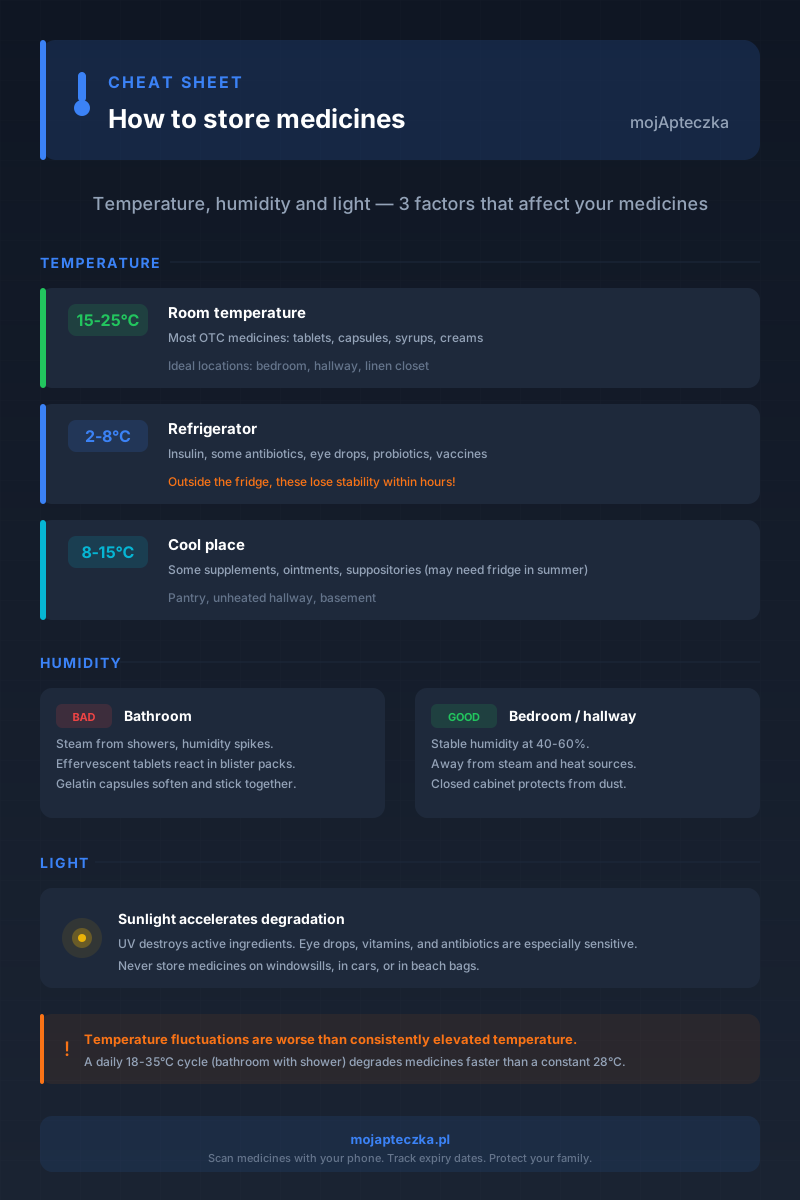
The bathroom cabinet above the sink. A classic place for a home medicine cabinet — and also one of the worst you can choose. Heat from the shower, steam hanging in the air, sudden temperature swings every time someone has a bath. If you were designing an environment that ruins medicines, the bathroom would come very close.
Yet most of us have kept medicines there for years. Because our parents did, because there is a mirror and water nearby, because it seems logical. The problem is that everyday logic does not match pharmaceutical chemistry.
Where should you store medicines at home?
Medicines should be stored in a dry, cool place away from sunlight, at 15–25°C. The best places are a bedroom cupboard, a hallway cupboard, or a closed cabinet in the living room. Never store medicines in the bathroom — steam from the shower and temperature changes speed up the breakdown of active ingredients.
Three conditions for correct storage:
- Temperature: 15–25°C (room temperature). A bathroom after a hot shower can reach 28–35°C — too high
- Humidity: below 60%. A bathroom can reach 80%+ after a bath — this damages tablets and capsules
- Light: store medicines in a closed cabinet, not on a shelf by the window. UV breaks down active ingredients
Why the storage location matters
Every medicine is a chemical system. The active ingredient, excipients, coating, preservatives — all of them react to their surroundings. Temperature, humidity and light are the three factors that affect a product’s stability most.
When these conditions worsen, degradation processes begin. The active ingredient breaks down into smaller molecules that no longer have a therapeutic effect. In some cases, breakdown products may have properties different from the original medicine — and not in a good way.
The effect is not immediate. You will not notice it after one hot day. But weeks and months in poor conditions shorten the medicine’s real shelf life, even if the expiry date on the pack is still in the future. The manufacturer guarantees that date only if the medicine is stored as recommended. If you keep it in a hot bathroom instead of a dry, cool place, that guarantee is purely theoretical.
Temperature — three zones you need to know
Most over-the-counter medicines are stored at room temperature, which means between 15 and 25 degrees Celsius. This is the range in which the manufacturer tested the product’s stability. On the pack, this may be described as “store below 25°C” or “store at room temperature”.
The second zone is the fridge, meaning 2–8 degrees. This mainly applies to some antibiotics in suspension, insulins, vaccines, some eye drops and probiotics that require refrigeration. If the pack says “store in a refrigerator”, this is not a suggestion — it is a requirement. Outside the fridge, this kind of medicine can lose stability within hours, not weeks.
The third zone is the rather vague “cool, dry place” that appears in many leaflets. In practice, it means 8–15 degrees — cooler than a typical room, but warmer than a fridge. A pantry, a hallway cupboard, an unheated corridor — these are places that usually meet this condition. A bathroom after a hot bath, a kitchen next to the oven, a sunny windowsill — definitely not.
Temperature fluctuations are especially risky. A medicine that goes through a daily cycle of 18–35 degrees (for example in a bathroom with a shower) degrades faster than a medicine kept constantly at 28 degrees. This is because repeated expansion and contraction of materials causes microcracks in tablet coatings and changes the structure of gels or ointments.
Humidity — the bathroom is the worst place
Humidity is the factor people consider least often. Yet its impact can be greater than temperature.
Water reacts with many active ingredients, speeding up their breakdown. Effervescent tablets that should dissolve in a glass can start reacting inside the blister if the surroundings are humid enough. Gelatin capsules soften, stick together and lose their structure. Inhalation powders clump and stop dispersing properly.
Steam from the shower is not the only source of the problem. A kitchen above steaming pots, a laundry room with a dryer, a basement without ventilation — in all these places, humidity regularly exceeds 60% and often reaches 80%. The recommended relative humidity for storing medicines is below 60%.
That is why the best place for a home medicine cabinet is a dry bedroom, hallway, or closed cabinet in the living room. Choose somewhere with stable temperature and low humidity, away from sources of steam and heat.
Light — the invisible enemy of tablets
UV radiation breaks chemical bonds in active ingredients. Some medicines are especially sensitive to this — which is why they are packed in brown bottles, dark blisters or aluminium packaging. This is not about appearance; it is about protection.
If you take tablets out of the original blister and move them into a transparent organiser for the week, you expose them to light they should not be exposed to. This applies especially to:
- nitroglycerin,
- vitamin B2 (riboflavin),
- nifedipine,
- some antibiotics (tetracyclines, metronidazole),
- many dermatological medicines.
The golden rule is simple: keep medicines in their original packaging. The manufacturer designed the packaging to protect the product — the blister, box and dark bottle are parts of the protective system, not unnecessary plastic.
Five most common mistakes
1. A medicine cabinet in the bathroom. You already know why — humidity and temperature swings. Move it to the bedroom or hallway.
2. Medicines on a windowsill or shelf by the window. Direct sunlight is an intense dose of UV that degrades active ingredients in days, not months. Even if the window faces north, many hours of scattered light still have an effect.
3. Medicines in the car. In summer, the temperature in a closed car can reach 60–70 degrees. A medicine left in the glove compartment in June may be useless by July. Do not leave medicines in the car for longer than the journey itself.
4. Taking tablets out of the blister “in advance”. Tablets in a blister are protected individually. Once removed, they go into a small box or pocket, where they are exposed to moisture, light and contact with other substances. Take a tablet out only when you are about to take it.
5. Ignoring information in the leaflet. “Store in a refrigerator” is not a suggestion for warm days. “Protect from light” is not about appearance. Every such sentence in the patient information leaflet comes from stability testing and has a specific chemical reason behind it.
What happens to a medicine stored incorrectly?
The consequences are not always dramatic, but they are always real.
Reduced effectiveness — the active ingredient breaks down, and the medicine works less well or not at all. You take a painkiller, the pain does not pass, so you take another. That is a simple route to taking too much of the other ingredients while still getting too little of the active ingredient.
Changes in physical properties — tablets crumble, capsules stick together, ointments separate, syrups become cloudy. If a medicine looks different from usual — its colour, consistency or smell has changed — do not use it, even if the expiry date is still fine.
Breakdown products — in rare cases (mainly tetracyclines, aspirin and insulin products), degradation products can be biologically active in unwanted ways. These are extreme scenarios, but they are worth knowing about.
How mojApteczka helps you keep track of your medicines
Even if you move your home medicine cabinet to the perfect place, you still need to keep control of expiry dates. A properly stored medicine will still expire — the difference is that it will do so according to the date on the pack, not six months early.
Expiry date alerts in mojApteczka send a notification a few weeks before the date passes. You do not need to remember when your ibuprofen expires or manually check every blister each month. The app does it for you and reminds you exactly when you need to make a decision: use the medicine, take it for disposal, or buy a new one.
If you want to add extra information about the storage conditions for a specific medicine — for example “keep in the fridge” or “sensitive to light” — you can do this in notes for each medicine. It is a simple way to make sure everyone at home knows where a given product should be kept.
Summary
Correct medicine storage does not require specialist equipment or pharmaceutical knowledge. Three rules are enough: keep medicines in a dry, cool place away from light; do not take them out of their original packaging; read the leaflets. Add regular expiry date checks, and your home medicine cabinet will work as it should. Storage is just one piece — for how to build and run the whole set of medicines, see our complete home medicine cabinet guide.
Start with one small step: move your medicine cabinet from the bathroom to the bedroom. Then scan your medicines in mojApteczka and turn on alerts. The whole process will take fifteen minutes, and the benefit will last for years. The Android app is also available on Google Play.
Questions about storing medicines? Write to us at kontakt@mojapteczka.pl — we are happy to help!