Poland's Medicines Register (RPL): A Guide
What the Polish Register of Medicinal Products (RPL) is, who runs it (URPL), what data it holds, and how mojApteczka uses the open dataset to find medicines.
A doctor has prescribed your mother a new product. A name you have never heard, in small print on the prescription. You type the first few letters into the app and a second later you see the full name, the active substance, and the form. How does the app know this? You have not scanned a single box yet.
The answer is the Register of Medicinal Products. It is a public, official list of every medicine authorised for sale in Poland — and it is the reason the app can “recognise” a medicine it has never seen before. This guide explains exactly what the register is, what data it holds, where the public data comes from, and how mojApteczka uses it. No clinical jargon, just the specifics about the source.
What the Register of Medicinal Products is
The Register of Medicinal Products, RPL for short, is the official list of medicines that may be legally sold in Poland. It is maintained by URPL — the Office for Registration of Medicinal Products, Medical Devices and Biocidal Products. That is the same authority that authorises medicines for sale and oversees their safe use.
Put simply: before any medicine reaches a pharmacy, it must go through registration. The manufacturer submits documentation, the regulator assesses it, and once it is approved the product is entered in the register. From that point it is “on the market” and has its own RPL entry. When the authorisation expires or the manufacturer withdraws the product, the entry loses its active status.
The register is therefore something like an identity card for every medicine in Poland. It does not say how a medicine acts on a particular person — that is not its job. What it does say is what the product is, who is responsible for it, and in what form it is authorised.
What a register entry contains
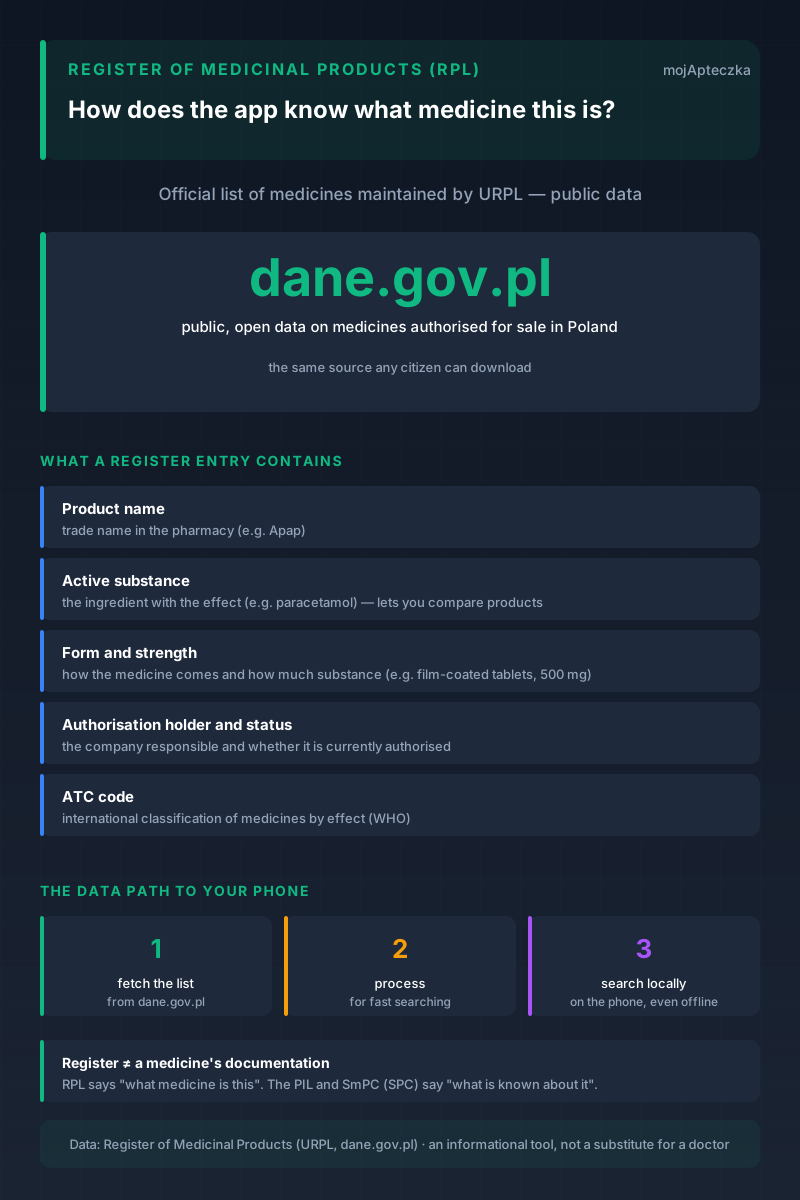
Every RPL entry is a set of structured information about a single medicinal product. The most important fields are:
- Product name — the trade name under which the medicine is sold in a pharmacy (e.g. Apap, Ibuprom).
- Active substance — the international name of the ingredient responsible for the medicine’s effect (e.g. paracetamol, ibuprofen). It is what lets you compare different “brands” of the same medicine.
- Form — the way the medicine comes: film-coated tablets, syrup, suppositories, solution for injection.
- Strength — the amount of active substance, e.g. 500 mg, 200 mg/5 ml.
- Marketing authorisation holder — the company responsible for placing the medicine on the market (not always the same as the manufacturer).
- ATC code — the international system for classifying medicines by their effect and chemical structure (Anatomical Therapeutic Chemical, developed by the WHO).
- Registration status — whether the medicine is currently authorised or the entry has lapsed.
One medicine can have several entries in the register — separate ones for different pack sizes or strengths. That is why the same product can appear under several barcodes while still being “the same” medicine.
Take an example. A common painkiller might have a register entry roughly like this: trade name “Apap”, active substance “paracetamol”, form “film-coated tablets”, strength “500 mg”, ATC code “N02BE01”. Each of those fields is a separate, comparable piece of information. That is how the app can tell that two different boxes with different names on the front contain the same substance — because in the register they share an identical “active substance” field.
One thing matters here: a register entry describes a product, not your health. There are no personal data, no treatment history, nothing sensitive. It is purely product information, and it is public.
Where the public RPL data comes from
This is the heart of the “how does the app know” question. The register is not a closed database available only to officials. The current list of medicinal products is published as open data on the government portal dane.gov.pl. It is the official repository of public data in Poland — you can download it, process it, and share it onward.
mojApteczka draws on exactly this public source. The file with the list of medicines is fetched automatically, processed into a form that is convenient for searching, and made available in the app. We do not buy a closed database from a middleman, nor do we guess the data — we reach for the same list any citizen can download for themselves.
That matters for two reasons. First, the source is open and verifiable — you know what the app rests on. Second, the data is updated regularly. The register of medicines is a living thing: one month a new product appears, the next a manufacturer withdraws an old one. mojApteczka refreshes its list to keep pace with changes in the register, with no manual update needed on your part. Syncing happens in the background.
The data path is simple and repeatable. The list is fetched from the public source and processed into a form that is useful in the app. Medicine search by name itself, however, uses a public NFZ endpoint and requires an internet connection, because results are fetched live. What can be available offline is the SmPC document card for a medicine whose data has already been synced.
The register is not the same as a medicine’s documentation
It is easy to confuse two things: a register entry and a specific medicine’s documentation. These are two different levels of information.
An RPL entry is an “inventory snapshot” — a short, structured record: name, substance, form, strength, status. That is enough to identify a product unambiguously and search for it by name.
A medicine’s documentation is far more. It consists of two types of document worth distinguishing:
- Patient information leaflet (PIL) — the folded sheet in the box. It is written in language a layperson can understand and summarises the key points: what the medicine is for, how to use it, what to watch out for.
- Summary of Product Characteristics (SmPC) — known in Polish as ChPL (Charakterystyka Produktu Leczniczego). It is the official pharmaceutical document approved by the regulator, intended for doctors, pharmacists, and nurses. It holds far more detail than the leaflet — full indications, dosing schemes, contraindications, interaction tables, classification of adverse effects.
In short: the leaflet is the summary, the SmPC is the full version. Both documents come from the regulator, but they differ in audience and level of detail. If you want to know how to read these documents, we have a separate guide to reading a medicine leaflet and a post on how SmPC documentation works offline on your phone.
The register answers “what medicine is this”. The documentation answers “what is known about it”. mojApteczka uses both layers, but they are two separate sources and two separate processes.
How mojApteczka uses the register data
Now that we know what the register is and where the data comes from, let us look at what it does in the app.
Searching for a medicine by name
This is the most direct use. You start typing a name — two letters are enough — and the app searches the list sourced from the register and suggests matching products. You see the full name, active substance, and form before you scan anything. That is why the app “knows” a medicine you have never had in your cabinet.
The search fetches results live from a public NFZ endpoint, so searching by name needs an internet connection. That is a different mechanism from offline access to the SmPC documentation of a previously synced medicine. If you want to see how this mechanism goes beyond the “the app only knows what you show it” limit, read the post on searching the full medicine database — that article focuses on the feature itself, this one on the data source beneath it. It is the medicine scanner and search in practice.
Substitutes by active substance
Since the register stores each medicine’s active substance and ATC code, products containing the same ingredient can be matched on that basis. That is the foundation of the medicine substitutes feature — when you are looking for a cheaper equivalent of what is on your prescription, the app compares products by active substance, not by trade name. There is more on the mechanics in the post on how to find a cheaper substitute.
Identification and order in your cabinet
When you add a medicine to your cabinet — whether by scanning the box or entering it by hand — the app matches it to a record in the list. As a result your medicine list is consistent: the same products are recorded the same way, no matter who added them or when. That in turn supports further features that work on tidy data, such as search by use or viewing a medicine’s leaflet and documentation.
What the register does not do in the app
It is worth saying plainly. Register data helps identify and organise a medicine — and that is all. It does not turn mojApteczka into a diagnostic tool. The app does not judge whether a given medicine is right for you, does not set a dose, and does not replace a consultation with a doctor or pharmacist. The register answers “what medicine is this”, not “should I take it”. We hold that line deliberately.
Why an open data source matters
In the world of health apps it is easy to promise the spectacular and gesture vaguely at “databases” of unknown origin. We prefer to be plain about it: the medicine database in mojApteczka rests on the public Register of Medicinal Products, available to everyone on dane.gov.pl.
This approach has practical consequences. You can verify for yourself that the data has an official origin. Updates flow from the same place as the register, so the app does not lag behind reality. And because it is open, product data, there is no trade in your information — the medicine list knows nothing about you.
If you manage medicines for a whole family or care for a loved one, that predictability is more valuable than it sounds. You know where you stand. The rest — reminders, order, sharing a list — you build on a solid, verifiable foundation. See how it looks in everyday use for caregivers.
Summary
The Register of Medicinal Products is the official list of every medicine authorised for sale in Poland, maintained by URPL. It holds basic product data on each preparation: name, active substance, form, strength, marketing authorisation holder, and status. The public version of this list is available as open data on dane.gov.pl — and it is precisely what mojApteczka uses to recognise medicines by name, match substitutes, and keep order in your cabinet.
The register is not the same as a medicine’s documentation: the leaflet (PIL) is a summary for patients, while the SmPC (ChPL) is the full document for professionals. mojApteczka helps you find and organise them, but does not replace a doctor or pharmacist. So the next time someone asks “how does the app know what medicine this is?”, you know the full answer — and you know it comes from an open, verifiable source.
Frequently asked questions
- What is the Polish Register of Medicinal Products (RPL)?
- It is the official list of every medicine authorised for sale in Poland, maintained by URPL — the Office for Registration of Medicinal Products, Medical Devices and Biocidal Products. For each product it holds the trade name, active substance, form, strength, marketing authorisation holder, and registration status.
- Where does the public RPL data come from?
- The current list of medicinal products is published as open data on the government portal dane.gov.pl. It is a public dataset that anyone can download. mojApteczka draws on this same public source.
- What is the difference between the patient leaflet (PIL) and the SmPC (SPC)?
- The patient information leaflet (PIL) is written in plain language and summarises the essentials. The Summary of Product Characteristics (SmPC, called ChPL in Polish) is the official document approved by the regulator for healthcare professionals — far more detailed than the leaflet.
- How does mojApteczka use the register data?
- RPL data powers the search-by-name feature, so you can find a product before you scan or buy it. The same basis drives features such as finding substitutes by active substance. The app refreshes the list to keep pace with changes in the register.
- Is the data in the app up to date?
- The list of medicinal products changes regularly — new products appear, others are withdrawn. mojApteczka syncs the data from the public source, so the database on your phone keeps pace with the register without any manual update on your part.
- Does register information replace a doctor's or pharmacist's advice?
- No. The RPL and SmPC are reference documents. mojApteczka helps you find and organise them, but it does not diagnose, set doses, or replace a conversation with a professional. If in doubt, consult a doctor or pharmacist.