Drug Interactions During Pregnancy — What to Check Before Taking Any Medicine
Drug interactions during pregnancy need particular care. See what to check with supplements, antibiotics, heartburn medicines and pain relief.
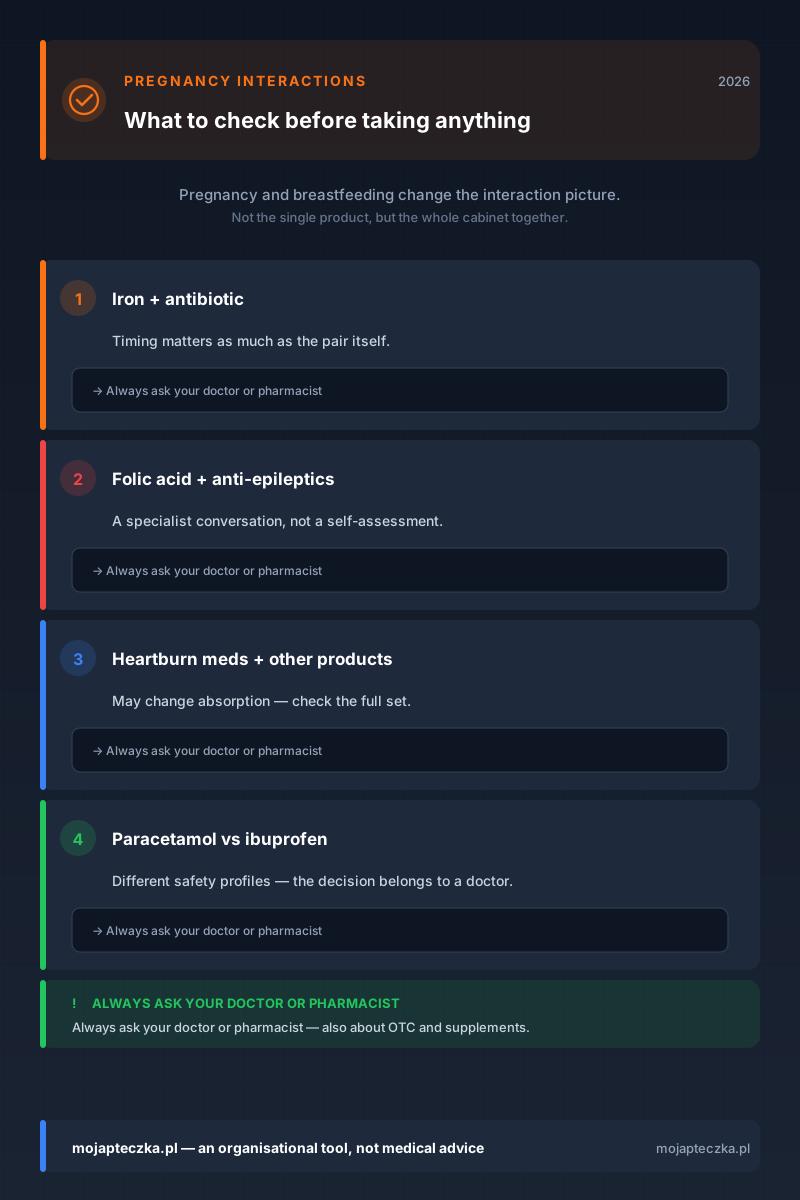
Pregnancy changes the way you look at the home medicine cabinet. Suddenly, the question is not only whether a product helps with a particular symptom, but also whether it clashes with something you are already using. There may be supplements recommended early in pregnancy, quick over-the-counter products, heartburn medicines, and sometimes an antibiotic or a regular medicine you were already taking before pregnancy. In that situation, drug interactions during pregnancy stop sounding like an abstract phrase from a leaflet. They become a practical question: what exactly should you check before adding anything new?
Start here: If you want orientation in the full drug-interactions ecosystem — categories, severity, and situations that need extra attention — begin with Drug interactions — a complete guide. This article dives deep into one specific category.
Important: This article is informational only. During pregnancy and breastfeeding, do not treat it as a list of what to take or what to avoid. Before combining any medicine, supplement or OTC product, consult your doctor or pharmacist.
If you want a broader discussion of the safety of different product groups, see our wider guide to medicines and pregnancy. Here, the focus is narrower: interactions, meaning what is worth checking when more than one product is involved.
Why Pregnancy and Breastfeeding Change the Interaction Picture
The same products may need a different conversation than before
Before pregnancy, many people move on autopilot. Headache means reaching for a familiar painkiller. Heartburn means something from the pharmacy that has always been around. Iron and an antibiotic may feel like two separate stories. In pregnancy that approach stops being enough.
What matters is not only the single product, but also what it is combined with, when you take it and whether supplements or as-needed OTC products are also involved. Pregnancy can also change digestive tolerance, daily rhythm and how easy it is to keep sensible gaps between products. In practice, that means one thing: even a familiar combination deserves checking again in the context of pregnancy.
After birth, you do not automatically go back to old habits
Breastfeeding is not a one-to-one extension of pregnancy, but it also does not mean complete freedom to add products to the home medicine cabinet. After birth, many families focus on organising care and quickly return to old reflexes: “it is only something for pain”, “it is only a supplement”, “it is only a heartburn medicine”. Yet it is still worth checking the whole set, especially if new products for you and products for the baby are appearing at home at the same time.
The safest rule is therefore simple: pregnancy and breastfeeding are two different stages, but in both, look at the full list first and only then ask about the specific combination.
Before Taking Anything, Build the Full List
Do not leave out the products that feel like background items
Most pregnancy interaction problems start with an incomplete picture. One person remembers folic acid and iron. Another thinks about a long-term medicine recommended before pregnancy. The heartburn product never makes it onto the list because it feels like a separate category. An OTC painkiller is sometimes left out because “it is only occasional”.
That is why a simple checklist helps:
- what you use regularly,
- what has been added since pregnancy began,
- what you take only now and then,
- what you buy over the counter,
- what you treat as a supplement or “natural support”.
If something is taken by mouth, used repeatedly or likely to be combined with another product from the home medicine cabinet, it belongs on the shared list.
First the list, then the interpretation
This matters because pregnancy is not about guessing from names. It is about preparing a good consultation. mojApteczka can help on the organisational side: a medicine scanner, data based on RPL for 78,000+ medicines, access to 8,000+ offline SmPC documents, and checks for known interactions in the DDInter 2.0 database, which covers over 300,000 combinations. But even the best tool does not replace a conversation with a doctor or pharmacist. Its role is to make that conversation based on a full list, not on memory.
Four Examples Worth Checking Carefully
Iron + antibiotics — the problem may be not only the pair, but also the timing
This is one of the most common pregnancy questions. Iron is often part of the supplementation plan, while an antibiotic may appear suddenly during an infection. These two products can potentially interact, and pregnancy may make the practical side of combining them even more visible because the day may already be shaped by nausea, meals and when you can manage to take anything at all.
So the issue is not only that both products appear on the list. It is also how to keep a sensible gap between them and whether, in your situation, the order or daily schedule needs adjusting. This is exactly the moment for a conversation with a pharmacist about timing, not for building a plan yourself from the internet.
What to check before the conversation:
- which iron product you actually have at home,
- which antibiotic was added,
- whether heartburn products or calcium are also present,
- whether you are struggling to keep sensible gaps between products.
Folic Acid + Some Anti-Epileptic Medicines
Folic acid is one of the first products you hear about when planning pregnancy and in its first weeks. At the same time, the medical literature clearly describes that some anti-epileptic medicines can change how this supplementation, and the whole care plan, should be considered. This is not a situation to base on a general article, a forum or a simple list of “safe medicines”.
If anti-epileptic medicines are on your list, the presence of folic acid does not close the subject. You need a conversation with the doctor who knows your treatment history and pregnancy plan. In this case, the interaction is not just about two names next to each other, but about the whole safety strategy.
This is not a reason to stop folic acid or any anti-epileptic medicine on your own. With some anti-epileptic medicines, folic acid supplementation can actually matter more than usual, not less. The specialist conversation is about adjusting the plan, not about whether folic acid or the medicine is the problem.
What to prepare:
- the full list of long-term medicines,
- information on how far along the pregnancy is, or whether you are planning one,
- the name and dose of the folic acid you are already using,
- questions about which parts of the plan need extra monitoring.
Heartburn medicines + other products — a classic interaction many people miss
Heartburn is so common in pregnancy that a product “for heartburn” can easily stop being seen as a proper part of the list. Yet this is exactly the group that can change the absorption of other medicines and supplements or make it harder to separate them sensibly over time.
In practice, the day may look like this: a supplement in the morning, a heartburn product later, then the wish to add something else for pain or an infection in the evening. Each element seems separate, but together they create a set worth checking. The category name “for heartburn” is not enough. The specific product and the full set around it are what matter.
If you use this kind of product in pregnancy, keep it on the full list and mention it in every pharmacy or doctor conversation about interactions.
Paracetamol and ibuprofen in pregnancy — similar use does not mean the same assessment
This is one of the most common shortcuts in a home medicine cabinet: if both products are associated with pain or fever, they must be simple substitutes. During pregnancy that assumption is too risky. Paracetamol and ibuprofen have different safety profiles, and the decision around either of them should come from professional advice, not from the fact that both are familiar and often available without a prescription.
This article is intentionally not answering “which one should I choose”, because that would be medical advice. The point here is different: if you are considering this pair, do not decide solely because both products are well known and may be available without a prescription. This is exactly when it is worth asking a doctor or pharmacist, even if the product is OTC.
Quick Table: When to Ask Immediately and What You Can Organise First
| Situation | When to ask your doctor or pharmacist without delay | What you can organise in mojApteczka first |
|---|---|---|
| A new antibiotic is added | when iron, a regular medicine or a heartburn product is already in the set | one complete list of medicines, supplements and OTC products |
| You have a supplement plan during pregnancy | when neurological, cardiac or hormonal medicines are also involved | record all products and check what is already duplicated |
| You want to take something for pain or fever | always, if you are pregnant or breastfeeding | quickly check whether the same active ingredient is already at home |
| You use heartburn products | when they are being combined with medicines or supplements | confirm product names, active ingredients and current timing |
| You restart old products after birth | when breastfeeding and a new medicine or supplement appears | update the home medicine cabinet after every change |
This table is not for making decisions instead of a specialist. It is there to help you see which situations call for a quick consultation and how to prepare for it better than relying on memory alone.
How mojApteczka Helps You Organise the Interaction Question
First create order, then ask better questions
During pregnancy and breastfeeding the biggest practical value is often not a quick search result, but one organised list of everything that is actually in use. In mojApteczka, you can collect medicines, supplements and OTC products in one home medicine cabinet, then check known interactions or look at source documents. This is especially important when several products come from different moments: something was at home before pregnancy, something was added after an appointment, and something was simply bought for occasional use.
If you want the fastest starting point, there is also the free interaction checker with no login required. For fuller organisation, Drug Interactions, Paediatric Classification and For Parents are the most relevant areas. In the free plan, you can add 20 medicines and use 3 AI scans per month. If you manage a larger family medicine cabinet, Standard is also available for 9.99 PLN per month and Pro for 19.99 PLN per month.
Informational support, not therapeutic advice
This boundary must be clear. mojApteczka is an organisational and informational tool. It helps you organise the home medicine cabinet, check known combinations and prepare a more useful conversation. It does not decide whether a product is suitable in your pregnancy or during breastfeeding. You always close that part with a doctor or pharmacist.
When a Leaflet and Memory Are Not Enough
With drug interactions in pregnancy, the problem is rarely that no information can be found. The problem is that there is too much information, it is scattered and it concerns individual products, while you need to see the whole set. A leaflet for one medicine will not conveniently show everything that may happen between several products from different categories.
That is why the practical sequence works like this:
- gather the full list,
- check for duplicated ingredients,
- flag the pairs that may interact,
- discuss the specific combination.
That is much safer than making a decision based on one search result.
CTA: Before Adding One More Product, Check the Full Set
During pregnancy and breastfeeding, the point is not to analyse everything alone. The point is to avoid guessing. If a new antibiotic, iron, heartburn product or painkiller appears in your home medicine cabinet, first gather the full set and check what requires consultation.
See also
- Our wider guide to medicines and pregnancy
- 10 Most Common Drug Interactions Hiding in Your Medicine Cabinet
- OTC Medicine Interactions — 7 Hidden Combinations Families Often Miss
Second disclaimer: If you are pregnant or breastfeeding, do not read the examples above as a personal yes-or-no answer for any specific medicine. Every combination, including OTC products and supplements, should be discussed with your doctor or pharmacist.
Sources
Frequently asked questions
- Can supplements during pregnancy interact with other medicines?
- Yes. A supplement does not act in isolation, especially when antibiotics, heartburn medicines or products used regularly are already part of the picture. Before combining any supplement with another product during pregnancy or breastfeeding, consult your doctor or pharmacist.
- Can I work out on my own whether iron and an antibiotic are safe together?
- It is better not to. What matters is not only the pair of products, but also the timing, the type of antibiotic and your situation in pregnancy. If that pair appears in your home medicine cabinet, consult your doctor or pharmacist.
- Are paracetamol and ibuprofen treated the same way in pregnancy?
- No. They are different products with different safety profiles during pregnancy and breastfeeding, so they should not be treated as simple substitutes. If you are considering either of them, consult your doctor or pharmacist.
- Can heartburn medicines affect other products used during pregnancy?
- Yes. Heartburn medicines can change absorption or make timing with other medicines and supplements more complicated, which is why they belong on the full list too. If you want to combine them with another medicine during pregnancy, consult your doctor or pharmacist.
- Does the issue of interactions go away after birth if I am breastfeeding?
- No. Breastfeeding is a different stage from pregnancy, but it still calls for caution when new products are added to the home medicine cabinet. If you are taking or planning to take any medicine while breastfeeding, consult your doctor or pharmacist.
- Is a free interaction checker enough to make the decision?
- No. It is a useful way to gather the list and flag known interactions, but it does not replace a medical consultation. If the result concerns pregnancy or breastfeeding, consult your doctor or pharmacist.