How to Read Drug Interaction Warnings in Patient Information Leaflets — A Practical Guide
Patient information leaflets describe interactions differently from a search engine. Learn how to read the warnings section, use ibuprofen as an example and know when a leaflet alone is not enough.
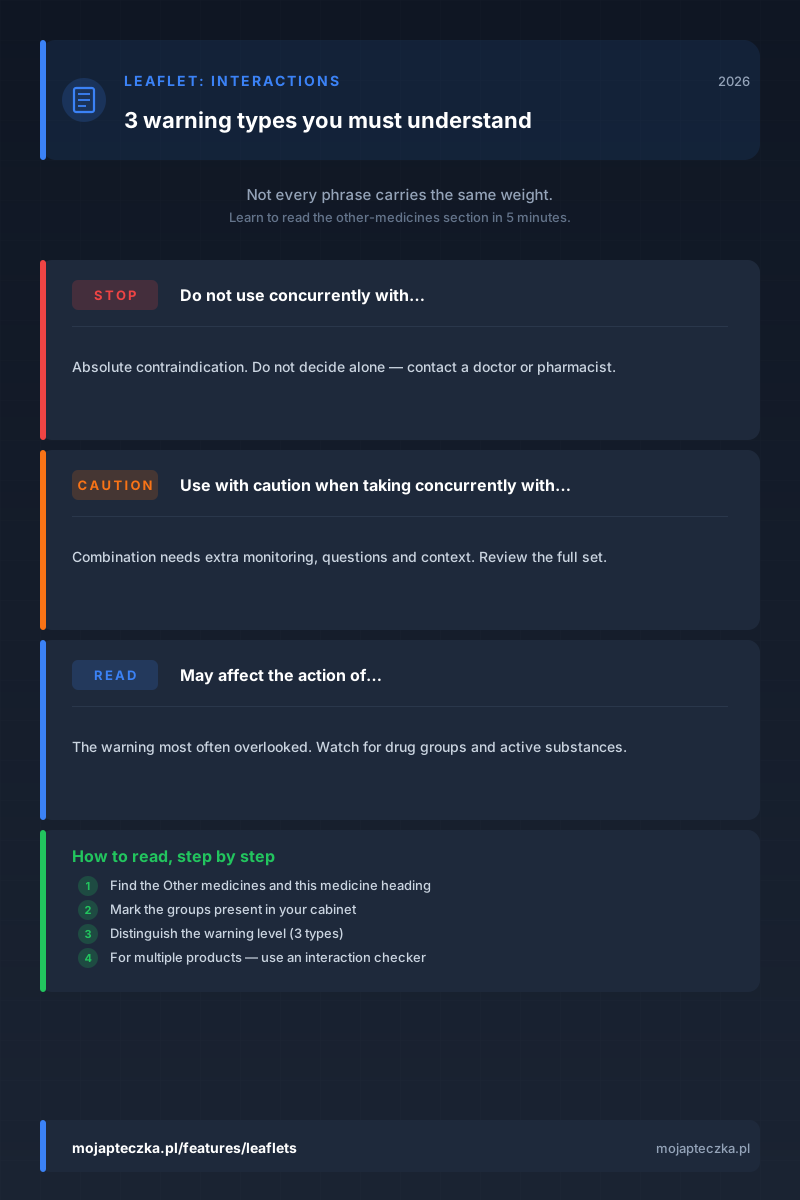
Patient information leaflets often lose out to urgency. You want one answer and get several pages of small print where drug interaction warnings can look like a random list of names. As a result, many people read only the first few lines or skip the “other medicines” section altogether because it feels too technical. Yet that is exactly where you find information that may decide whether a product should be combined with what is already in your home medicine cabinet.
Start here: If you want orientation in the full drug-interactions ecosystem — categories, severity, and situations that need extra attention — begin with Drug interactions — a complete guide. This article dives deep into one specific category.
This article is not a general guide to the whole leaflet. We already have one: How to Read a Medicine Leaflet — Guide to PIL and SmPC. Here, we focus only on interaction warnings. The goal is to help you find the right section quickly, recognise the weight of the wording and know when one leaflet is no longer enough.
Important: This article is informational. A leaflet helps you understand risk, but it does not replace a conversation with a doctor or pharmacist, especially when several products are involved at the same time.
Anatomy of an Interaction Section in a Patient Information Leaflet
You will usually find it under a heading such as “Other medicines and this medicine”, “This medicine and other medicines” or in the warnings before use. The section is not always long, but it is rarely written in the same language people use when asking questions at home. That is why it helps to understand not only the names, but also the type of warning.
“Do not use together with…” — absolute contraindication
This is the strongest form of warning. If you see this type of statement, the leaflet is not suggesting caution or observation. It is saying directly that the combination is treated as contraindicated or should not be used without a specialist’s decision.
In practical terms, this is not the moment to guess whether “just once” or “a small dose” changes anything. Treat this wording as a signal to stop and contact a doctor or pharmacist.
“Use with caution when taking together with…” — the combination needs monitoring
This wording can be misleading because it sounds softer than the previous warning. It does not mean the issue can be ignored. It usually means the combination may need closer attention, symptom monitoring, a review of the other products on your list or an additional consultation.
For a home medicine cabinet, this is an important distinction. This wording does not give you a ready-made “yes” or “no”. It says: pause and check more widely.
“May affect the action of…” — compare the full set
This is one of the most common and most easily dismissed warning styles. Many people read it as a minor detail. In reality, this kind of sentence often opens up the possibility that one product may weaken the effect of another or intensify another product’s effect.
This is where active ingredients and medicine groups matter most. A leaflet may not list every brand name you have at home, but it can point to the group your product belongs to.
Step by Step: Reading the Ibuprofen Leaflet Interaction Section
Ibuprofen is a good example because many people keep it at home and treat it as a familiar product. That is exactly why it is easy to stop reading its leaflet carefully.
Step 1. Go straight to the section about other medicines
Do not start with side effects or dosage if your question is about interactions. Go straight to the section about other medicines. That is where you will see which product groups are most often mentioned with ibuprofen in the warnings.
Step 2. Mark the groups that already exist in your cabinet
On an ibuprofen leaflet, you will usually see references to other non-steroidal anti-inflammatory drugs, aspirin, anticoagulants, some blood pressure medicines and selected products used for kidney problems. You do not need to remember everything. It is enough to compare those groups with what you actually have at home.
That matters because someone may not connect “aspirin for the heart” with ibuprofen at this point. Or they may not realise that two painkillers in the home medicine cabinet belong to a similar group, even though they have different brand names.
Step 3. Notice whether the leaflet mentions bleeding risk, reduced effect or greater strain on the body
Good leaflet reading is not about memorising everything word for word. It is about picking up the direction of the warning. Is it about a higher risk of side effects? The possibility that another medicine may work less well? Extra strain on the stomach, kidneys or blood clotting? These signals help you decide whether you should ask a pharmacist straight away.
Step 4. Check whether an OTC product at home also falls into the same picture
This is the point many people miss. The ibuprofen leaflet is not only about prescription-only medicines. If there is another painkiller at home, something “for a cold” or a combination product, it can also matter for the interaction section. That is why it is worth reading it alongside OTC Drug Interactions — 7 Hidden Combinations Families Often Miss.
Step 5. If there is more than one possible pair, do not stop at one leaflet
If you can see that ibuprofen overlaps with several other products in your home medicine cabinet, one leaflet becomes too narrow. It shows the perspective of one medicine. It does not conveniently show the whole arrangement of several products. That is the moment to use an interaction checker and treat the leaflet as a starting point rather than the last word.
How mojApteczka Shows This in a More Readable Format
One problem with a paper leaflet is that it describes a single medicine. At home, you almost always need to look at more than one product at once. mojApteczka helps connect those two realities.
First, you can use Leaflets instead of searching through drawers for the paper version. Second, you can combine this with Drug Interactions, which helps you check known relationships between products in the same home medicine cabinet. That is easier than jumping between three leaflets and trying to remember the names.
In addition, mojApteczka gives access to RPL data for 78,000+ medicines, 8,000+ offline SmPC documents and the free checker at check-interactions. In the free plan, you can manage a cabinet of up to 20 medicines and use 3 AI scans per month. For larger family medicine cabinets, there are also Standard at 9.99 PLN per month and Pro at 19.99 PLN per month.
When the Leaflet Is Not Enough
A leaflet is excellent for understanding one medicine. It is not enough when:
- you are comparing several medicines at the same time,
- supplements or herbs are also part of the cabinet,
- brand names do not mean anything to you and you need to look at active ingredients,
- you want to see quickly which pairs deserve the most attention.
That is why it is worth combining leaflet reading with an organised list of the whole home medicine cabinet. If you want a wider background, also return to 10 Most Common Drug Interactions Hiding in Your Medicine Cabinet.
CTA: Read the Interaction Section, Then Check the Whole Set
The best habit is not “read every line of every leaflet from start to finish”. It is: find the interaction section, understand the type of warning and compare it with what you really have at home. When several products are involved, check the whole set instead of guessing.
See also
Frequently asked questions
- Does the interaction section in a leaflet also apply to over-the-counter medicines?
- Yes. A leaflet is not limited to prescription-only medicines. If you take OTC products, supplements or herbal preparations, you should also compare them with the warnings in the leaflet.
- What does “use with caution when taking together with” usually mean?
- It usually means the combination needs extra attention, further questions or closer monitoring, not guesswork at home. It is worth reviewing the full set and discussing it with a doctor or pharmacist.
- If my medicine name is not listed on the leaflet, does that mean the combination is safe?
- No. Leaflets often list medicine groups or examples rather than every brand name on the market. That is why you need to look at active ingredients and product groups, not only the name on one box.
- Why is one leaflet not enough when I take several products?
- Because it shows the perspective of one product. If several medicines, supplements and OTC products are in the same cabinet, you need to see the full set rather than one leaflet on its own.
- Is it worth combining leaflet reading with an interaction checker?
- Yes. A leaflet shows the official warnings for one medicine, while an interaction checker helps organise the relationships between several products in the same home medicine cabinet. That combination is useful, but it still does not replace medical advice.