Antibiotics and Alcohol: Dairy and Probiotics
Antibiotics with alcohol, dairy, grapefruit and probiotics — where to look in the leaflet for warnings, what to ask your pharmacist, and how to organise the gaps in mojApteczka.
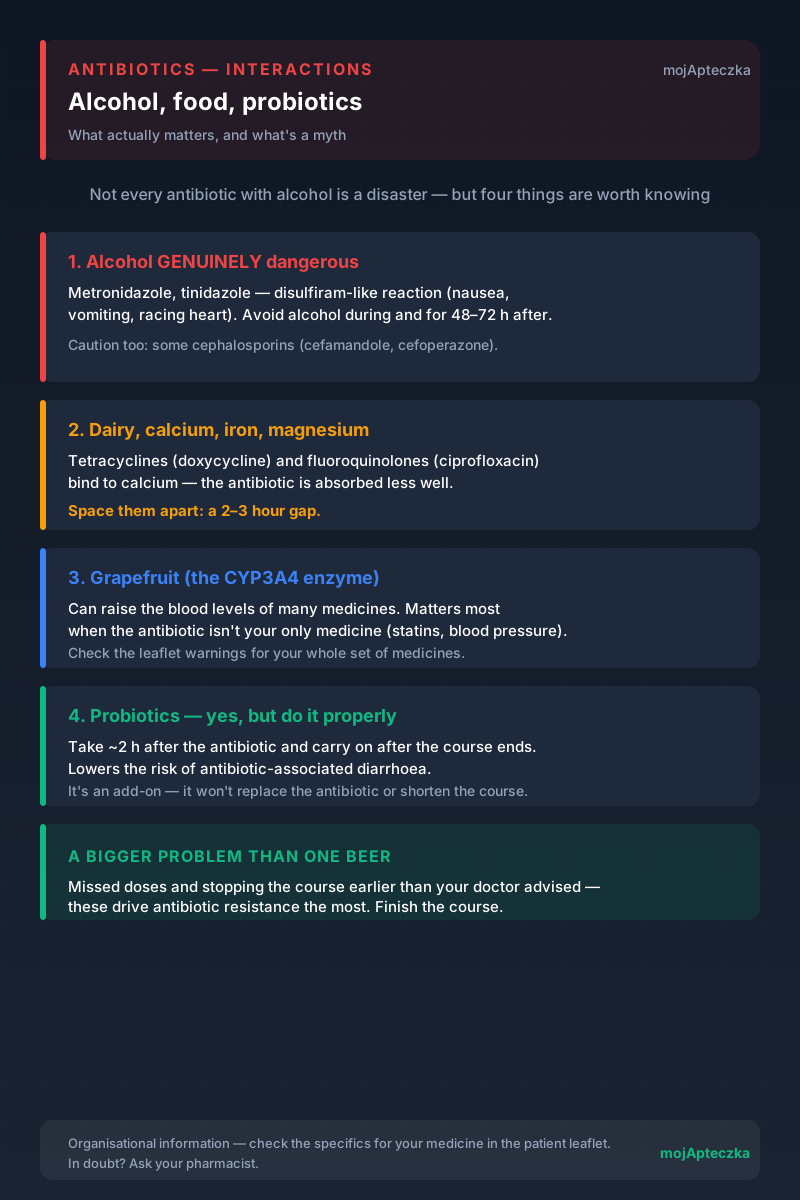
Your doctor has put you on a five-day antibiotic, and you’ve got a family party lined up for Saturday. Or you’re taking tablets for an infection and wondering whether your morning coffee with milk will spoil anything. Somewhere at the back of your mind you hear your grandmother’s “not a drop of alcohol on antibiotics” — but does every medicine’s leaflet say the same thing?
In this guide we’ve gathered the questions worth checking in the leaflet or with your pharmacist: antibiotics with alcohol, dairy, grapefruit and probiotics. This is organisational knowledge — it’s meant to help you ask the right question and read the leaflet with understanding. It doesn’t replace your doctor’s advice or the leaflet for your medicine, and the instructions in those always take precedence.
The myth that “any antibiotic plus alcohol is a disaster”
The belief that alcohol with any antibiotic always ends in drama is a big oversimplification. The leaflets of different antibiotics carry different warnings: with some medicines the warning about alcohol is very clear, while with others the emphasis falls more on side effects, on the state of the body, or on other medicines you’re taking. So it can’t be summed up in one sentence for every antibiotic — the point of reference is the leaflet for the specific medicine, not a general rule.
Whatever the leaflet says about the reaction with the medicine itself, alcohol during an infection usually works against you: it dehydrates you, taxes the liver, disrupts sleep and amplifies the usual complaints — nausea, headache, drowsiness. When your body is fighting an infection, that’s the last thing it needs. So where did such a widespread, categorical ban come from? Partly from caution — it’s simpler to say “don’t drink at all” than to explain each leaflet one by one. And partly from real, if rarer, cases where the warning in the leaflet is unmistakable.
Antibiotics whose leaflet more often warns about alcohol
The names that come up most often are metronidazole and tinidazole (used for oral, gynaecological or gastrointestinal infections, among others). The leaflets of medicines with these substances usually carry a clear warning about alcohol, along with a note on how long after the last dose to avoid it — a so-called disulfiram-like reaction is sometimes described there (strong nausea, vomiting, facial flushing, headache, palpitations). Rather than memorising a general number of hours, copy the exact wording from the leaflet for your medicine, or confirm it with your pharmacist. Remember the “hidden” alcohol the leaflet also mentions — in some cough syrups, tinctures or mouthwashes.
Caution is sometimes flagged with some cephalosporins too (such as cefamandole and cefoperazone). A slightly different case is linezolid — here the leaflet draws attention mainly to tyramine (mature cheeses, cured meats, fermented dishes, some beers) rather than to alcohol itself. This isn’t a complete list, just the situations you’ll meet most often — for your medicine, always check its leaflet. If you see an alcohol warning there, take it seriously; if you’re not sure, check your medicines for interactions or ask your pharmacist.
Dairy, calcium and iron — when the leaflet asks for a gap
This usually isn’t about a health risk but about the antibiotic being absorbed less well. With tetracyclines (doxycycline, for instance) and fluoroquinolones (such as ciprofloxacin), the leaflet often warns against taking a dose together with calcium, magnesium and iron — because they form compounds that are absorbed poorly. In practice, the leaflet may advise against taking the medicine at the same time as a glass of milk, yoghurt, cheese, a calcium or magnesium supplement, an iron tablet or a heartburn medicine.
The solution is simple and organisational: if the leaflet gives a gap or an order, write it into a reminder exactly as it’s described. It’s one of those details that’s easy to overlook when you’re juggling several medicines at once — which is why it helps to keep a schedule in one place. We write more about the pitfalls of combining medicines in our guide to the most common dangerous interactions at home.
Grapefruit — a small fruit, a frequent warning in the leaflet
Grapefruit and grapefruit juice are among the more common food warnings in leaflets — they affect an enzyme (CYP3A4) that breaks down many substances in the gut and liver, so they can raise the levels of those substances. Importantly, these warnings concern not only some antibiotics but also many medicines taken alongside them: cholesterol statins, some blood-pressure medicines, sedatives. That’s why the real problem usually appears when the antibiotic isn’t the only medicine you’re taking.
If you take other medicines regularly and an antibiotic gets added on top, this is a good moment to check the warnings in the leaflets for the whole set, not just the antibiotic on its own. Treat herbs and supplements with the same care — we write about how much they can stir up in our piece on supplements and drug interactions.
Probiotics — what to ask and what to note down
An antibiotic doesn’t tell “bad” bacteria from “good” ones, so after a course your gut flora is often depleted, and a common upshot is antibiotic-associated diarrhoea. Whether to take a probiotic, which one and when depends on the specific product and strain — there’s no single, universal rule. The probiotic’s leaflet, or your doctor’s or pharmacist’s advice, may name specific strains and a gap from the antibiotic; the strain name, the gap and how long to take it are best checked there and then noted down in your reminders.
From an organising point of view, one thing is worth remembering: a probiotic is an add-on to the course, not a substitute for it — it doesn’t shorten treatment and doesn’t replace the antibiotic. And if your immunity is lowered, you’re seriously ill or you have doubts, don’t set one up on your own “blind” — ask your doctor or pharmacist whether, and which, product is right for you.
How to handle it organisationally — without counting in your head
Most mistakes come not from a lack of knowledge but from the rush: antibiotic, probiotic, a meal with dairy, plus the medicines you take regularly. Rather than keeping it all in your head, turn the leaflet’s and your doctor’s instructions into specific reminders:
- Copy the antibiotic times from the prescription and leaflet — exactly as your doctor advised, without your own changes for convenience.
- Check the leaflet for whether the medicine asks for a gap from dairy, calcium, iron, magnesium or heartburn medicines — if it does, write that gap in as part of the reminder.
- If your doctor or pharmacist has recommended a probiotic, add the recommended gap as a separate reminder.
- Treat the leaflet’s alcohol and grapefruit warnings as a note to remember for the duration of the course.
This is an organisational approach, not a prescription — the binding parts remain the times and rules from the leaflet and from your doctor. With one medicine it’s a trifle; with several at once, a written schedule simply works more reliably than counting in your head.
The most important thing isn’t on your plate — finish the course
We’ve focused on alcohol and dairy, but in fairness we should say where treatment success most often falls apart: on taking the medicine regularly and finishing the course as your doctor advised. Missed doses and “I feel better, so I’ll stop” are worth discussing with your doctor or pharmacist — don’t trade one form of caution (a glass of wine) for the opposite extreme (stopping treatment). If your doctor has set a length for the course, the simplest thing is to write it into your schedule without shortening it on your own.
There are also situations where there’s nothing to put off and nothing to check on your phone: a severe rash, breathlessness or facial swelling after an antibiotic are possible signs of an allergic reaction — then call for help. The same goes for diarrhoea that is sudden, with a high fever or blood. You don’t make those decisions with an app, but with a person on the other end.
A quick cheat sheet — what to check in the leaflet
- Alcohol: whether the leaflet lists a warning and for how long (e.g. after a dose) — copy that from the leaflet for your medicine.
- Dairy, calcium, iron, magnesium, heartburn medicines: whether the leaflet asks for a gap or an order (common with tetracyclines and fluoroquinolones).
- Grapefruit: whether it’s among the warnings — especially if you take other medicines regularly.
- Probiotic: which product/strain and what gap your doctor or pharmacist recommended.
- Doses: copy your doctor’s schedule without your own changes, and don’t stop the course early.
How mojApteczka helps you stay on top of a course
mojApteczka is a home medicine cabinet organiser, not a medical advisor — and it’s most useful precisely in the organising side of a course of antibiotics. Once you save your medicines, the app gathers the product names in one place, lets you add leaflets, flags basic interactions between them as a starting point for checking, and reminders help you keep to the gaps recommended in the leaflet and by your doctor. If you look after a family member, a shared medicine cabinet lets you see their saved medicines and reminders remotely.
You don’t even need to set up an account to start: type your medicine names into the free interaction checker and treat the result as a hint about what else to check in the leaflet or with your pharmacist. And for how alcohol tends to be described with other groups of medicines — not just antibiotics — read our practical guide to medicines and alcohol.
A well-kept schedule helps you stick to your doctor’s instructions and not miss doses. The rest comes down to a few simple gaps from the leaflet — and a little order in your medicine cabinet.
Sources
- Kiedy antybiotyk nie leczy — pacjent.gov.pl
- Rejestr Produktów Leczniczych — wyszukiwarka ulotek i ChPL
- Visapää JP et al., Lack of disulfiram-like reaction with metronidazole and ethanol (2002) — PubMed
- Bailey DG et al., Grapefruit-medication interactions (CMAJ 2013) — PubMed
- WHO — Antimicrobial resistance (fact sheet)
Frequently asked questions
- Can you really not drink alcohol with any antibiotic?
- There's no single rule that covers every antibiotic — the answer depends on the specific medicine. Leaflets differ. For some medicines (those with metronidazole or tinidazole, for example) the warning about alcohol is very clear; for others the emphasis falls on side effects and on the strain an infection already puts on the body. So don't judge it in general terms — check the leaflet for your medicine (the Summary of Product Characteristics) and ask your pharmacist.
- Which antibiotics is alcohol clearly advised against with?
- In the leaflets of some medicines — those with metronidazole or tinidazole among others — there's a clear warning about alcohol and a note on how long after the last dose to avoid it; a so-called disulfiram-like reaction is sometimes mentioned there. Copy the exact time and rules from the leaflet for your medicine, or confirm them with your pharmacist. Caution is sometimes flagged with some cephalosporins too, while for linezolid the leaflet focuses mainly on tyramine.
- Why does the leaflet advise against combining tetracyclines with dairy?
- With tetracyclines (doxycycline, for instance) and some other antibiotics, the leaflet may warn against taking them at the same time as dairy, calcium, magnesium, iron or heartburn medicines, because these can weaken how the medicine is absorbed. If the leaflet gives a gap or an order, write it into a reminder in exactly that form; if in doubt, ask your pharmacist.
- When should you take a probiotic during a course of antibiotics?
- That depends on the product and the strain — if the probiotic's leaflet, your doctor or your pharmacist suggests a gap from the antibiotic, note it down as a separate reminder. Information about how long to take it and the possible benefits varies between products, so it's worth confirming in the leaflet or with your pharmacist. A probiotic doesn't replace the antibiotic and doesn't shorten the course.
- Does grapefruit affect antibiotics?
- The leaflets of some medicines carry a warning about grapefruit or grapefruit juice, because it can affect how certain substances are metabolised and raise their levels. This concerns not only some antibiotics but also many medicines taken alongside them (for cholesterol, blood pressure, or anxiety). Check the warnings for each medicine separately, especially when you're taking several products at once.
- Which is the bigger problem — one beer or a missed dose?
- If your doctor has set out a schedule and a length for the course, it's best to copy these into a reminder without your own changes, rather than fixating on alcohol alone. Any doubts about a missed dose, alcohol or stopping the course early are worth discussing with your doctor or pharmacist — they, not an app, are the ones who assess the situation.
- How do I know whether my antibiotic interacts with anything?
- The most reliable source is the leaflet inside the box (the Summary of Product Characteristics). You can also enter your medicines into the free interaction checker on mojapteczka.pl, or save your whole home medicine cabinet in the mojApteczka app — treat the result as a starting point for checking the leaflet or talking to your pharmacist, not as a medical decision. When in doubt, ask your pharmacist — it's a free and quick consultation.