Over-the-Counter Medicines — Does OTC Really Mean Safe?
Do you buy over-the-counter medicines thinking they are completely safe? Learn what risks OTC medicines can carry and what to watch out for.
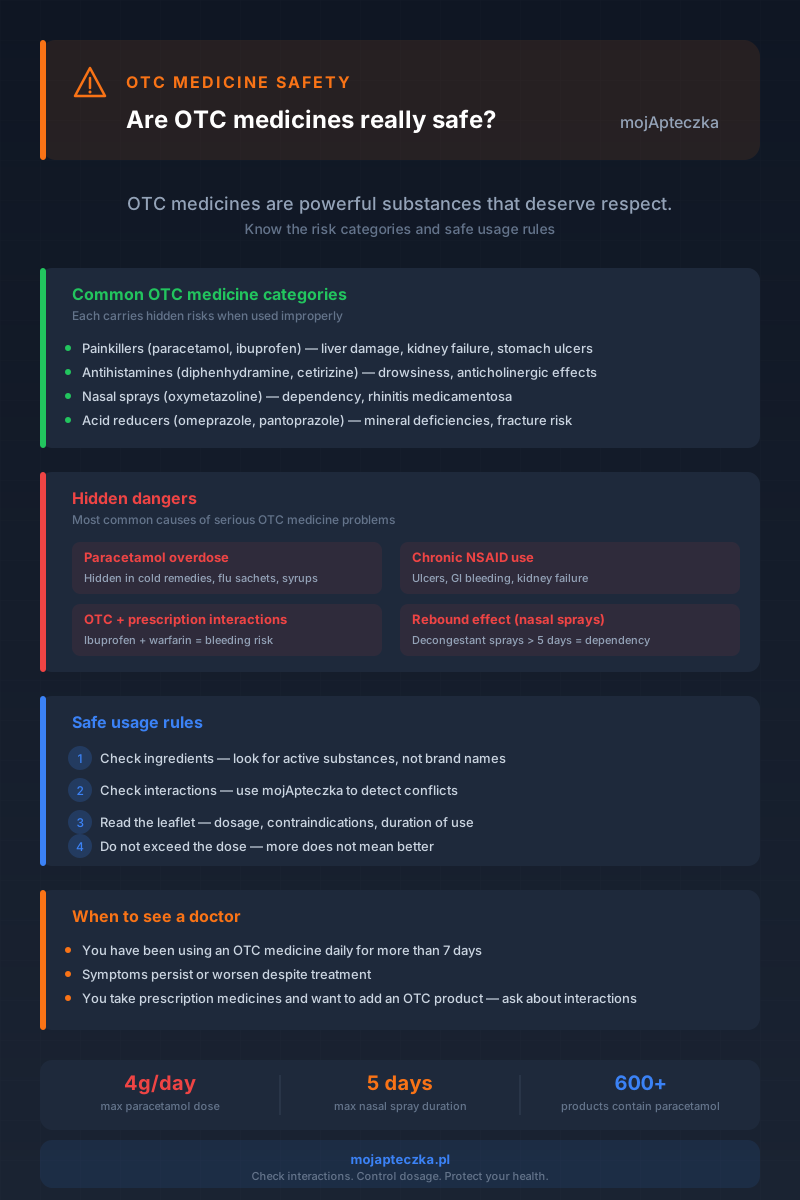
OTC. Over the counter. Without a prescription. Three phrases that, for most people, mean one thing: “I can take this without worrying.” And that is one of the most dangerous myths in modern self-care.
Over-the-counter medicines go through strict registration procedures. They are approved for sale without a prescription precisely because, at specific doses and for specific indications, they are safe enough for patients to use on their own. But “safe enough when used correctly” is very different from “harmless no matter how, or how much, you take”.
This article is not meant to frighten you. It is meant to give you the knowledge to use OTC medicines with awareness, because these are genuinely powerful substances and they deserve respect.
Myth one: “It is over the counter, so I can take as much as I want”
This myth sends thousands of people to emergency departments across Europe every year. And it most often involves a medicine you probably have several packs of in your home medicine cabinet: paracetamol.
Paracetamol (acetaminophen) is safe and effective at recommended doses. For an adult, that means 500-1000 mg per dose, up to a maximum of 3-4 grams per day, for a short period. The problem starts when people exceed those doses, not because they intend to overdose, but because they do not realise how much paracetamol they are actually taking.
Because paracetamol is everywhere. It is in cold medicines (Coldrex, Gripex, Fervex). It is in combination pain medicines, for example with codeine. It is in “flu” tablets. You take paracetamol for a headache, then cold tablets that also contain paracetamol, then a night-time syrup that contains paracetamol as well, and suddenly you are taking 5-6 grams a day without realising it.
Paracetamol overdose causes liver damage. Not immediately: symptoms appear after 24-72 hours, when the damage is already advanced. That is the danger. You feel fine, so you think everything is all right, while your liver is already under strain.
The rule: always check the ingredients of combination medicines. If you take paracetamol separately, do not take another combination medicine that contains it at the same time.
Myth two: “Ibuprofen is mild”
Ibuprofen is another medicine that people treat almost like a sweet for pain. And yes, when used briefly at recommended doses, it is relatively safe. Problems begin when use is no longer brief.
Chronic use of ibuprofen and other non-steroidal anti-inflammatory drugs (NSAIDs) is associated with serious risks:
- Stomach and duodenum. NSAIDs inhibit the production of prostaglandins, which protect the stomach lining. With regular use, they can lead to erosions, ulcers and gastrointestinal bleeding. The risk rises with age and with concurrent use of corticosteroids or anticoagulants.
- Kidneys. NSAIDs reduce blood flow through the kidneys. In people with existing kidney disease, dehydration, or other medicines that put strain on the kidneys (such as ACE inhibitors or diuretics), they can lead to acute kidney failure.
- Blood pressure. Ibuprofen and other NSAIDs raise blood pressure and can weaken the effect of blood pressure-lowering medicines. If you take medicines for high blood pressure and also regularly reach for ibuprofen for back pain, your blood pressure medicines may not work as they should.
- Heart. Large meta-analyses have shown that long-term NSAID use, especially at high doses, increases the risk of heart attack and stroke. Not dramatically, but measurably.
This does not mean ibuprofen is bad. It means it is not trivial. Use it when you need it. Do not use it every day “just in case”.
Myth three: “Antihistamines? They are only for allergies, nothing serious”
First-generation antihistamines, such as diphenhydramine (an ingredient in many OTC sleep medicines), clemastine and hydroxyzine, have strong sedative and anticholinergic effects.
What does that mean in practice? Drowsiness, slower reactions, dry mouth, blurred vision, urinary retention in men with an enlarged prostate, and constipation. In older adults, it can mean disorientation, confusion and an increased risk of falls.
Popular over-the-counter sleep medicines, for example those containing diphenhydramine or doxylamine, are essentially older-generation antihistamines marketed differently. They are effective for sleep, but they have an adverse-effect profile that manufacturers do not exactly shout about in adverts.
Second-generation antihistamines (cetirizine, loratadine, fexofenadine) are much safer in this respect: less drowsiness, fewer anticholinergic effects. But even cetirizine causes drowsiness in some people, especially at higher doses.
Myth four: “Nasal drops? It is just water with medicine in it”
Nasal drops and sprays with vasoconstrictor active ingredients, such as oxymetazoline and xylometazoline, work brilliantly. A blocked nose becomes clear in five minutes. The problem is that they work so well that it can be hard to stop using them.
Using these products for more than 5-7 days leads to the so-called rebound effect (rhinitis medicamentosa). The nasal lining becomes swollen not because of the infection, but because the medicine has been stopped. The nose is more blocked than it was before treatment. So you take another dose. That is how a vicious circle begins, and getting out of it can take weeks.
Some people use oxymetazoline every day for years. Their nasal lining is in poor condition: overgrown, dependent on the medicine and prone to bleeding.
The rule: decongestant nasal drops, maximum 5 days. If your nose is still blocked after that, see a doctor. Alternatives for longer-term use include saline sprays or intranasal corticosteroid sprays (for example budesonide or mometasone, available without a prescription in many countries, though some require a prescription in Poland).
Myth five: “I can take heartburn medicines every day”
Antacids, for example products based on aluminium and magnesium hydroxide, are safe when used occasionally. With long-term daily use, magnesium can cause diarrhoea, aluminium can lead to constipation, and in extreme cases electrolyte disturbances can occur.
But another group is more problematic: proton pump inhibitors (omeprazole, pantoprazole, esomeprazole). Some of them are available without a prescription in many countries. They are extremely effective, which is exactly why people use them for months or years, even though they were designed for 2-8 week courses.
Chronic PPI use is associated with risks including magnesium deficiency (paradoxical, because heartburn medicines can cause it), reduced absorption of vitamin B12, and a potentially increased risk of osteoporotic fractures and gut infections (Clostridioides difficile).
This does not mean you should not take omeprazole if your doctor has recommended it. It means you should not buy it over the counter and take it every day for a year because “it helps with heartburn”. If you have heartburn every day, you need an assessment, not another tablet.
OTC interactions with prescription-only medicines: the invisible risk
This is probably the least understood aspect of over-the-counter medicines. People tell their doctor about prescription-only medicines, but they forget, or do not think it matters, to say that they regularly take ibuprofen, magnesium, a mega-dose of vitamin D and cough syrup with dextromethorphan.
Yet interactions are real:
- Ibuprofen + warfarin = increased risk of bleeding.
- Ibuprofen + ACE inhibitors = weaker blood pressure-lowering effect + risk of kidney damage.
- Paracetamol at high doses + warfarin = increased anticoagulant effect.
- Omeprazole + clopidogrel = reduced effectiveness of clopidogrel (a medicine that helps prevent blood clots).
- St John’s wort (an OTC herbal supplement) + almost everything = St John’s wort is one of the strongest inducers of liver enzymes and weakens the effect of dozens of medicines.
- Magnesium + antibiotics (tetracyclines, fluoroquinolones) = reduced absorption of the antibiotic.
Each of these scenarios is common. Each is well documented. And each is easy to miss.
How to protect yourself
Before you reach for an OTC medicine, do three things.
First, read the ingredients. Not the brand name, but the active ingredient. Check whether you are taking the same active ingredient in two different products.
Second, check for interactions. If you take any prescription-only medicines, check whether the OTC medicine you plan to take interacts with them. In mojApteczka, you can do this using the drug interaction checker: choose medicines from your home medicine cabinet and see potential conflicts.
Third, read the patient information leaflet. Really. Not all of it, but the sections on “Dosage”, “Contraindications” and “Interactions with other medicines”. In mojApteczka, you have quick access to this through the leaflets feature, which lets you review medicine information without rummaging through the box.
An OTC medicine is still a medicine
Availability without a prescription is the result of a regulator’s assessment that, under specific conditions of use, the medicine is safe enough for self-care. It is not a certificate of harmlessness.
Every medicine, whether OTC or prescription-only, has a dosage, contraindications, interactions and potential adverse effects. The difference is that with OTC medicines, you are responsible for following them, because there is no prescribing doctor overseeing their use.
Take it seriously. Not because you need to be afraid of ibuprofen, but because you deserve to know what you are taking and why.
If you want to keep your home medicine cabinet organised, know what you have, what may interact with what, and when something will expire, try mojApteczka. Conscious medicine use starts with knowing what is in your cupboard. The Android app is also available on Google Play.
Questions or suggestions? Write to us at kontakt@mojapteczka.pl