Home Medicine Cabinet — Legal Regulations 2026
What rules apply to storing medicines at home? Pharmaceutical law, disposal, workplace and car first aid kits — a complete guide for 2026.
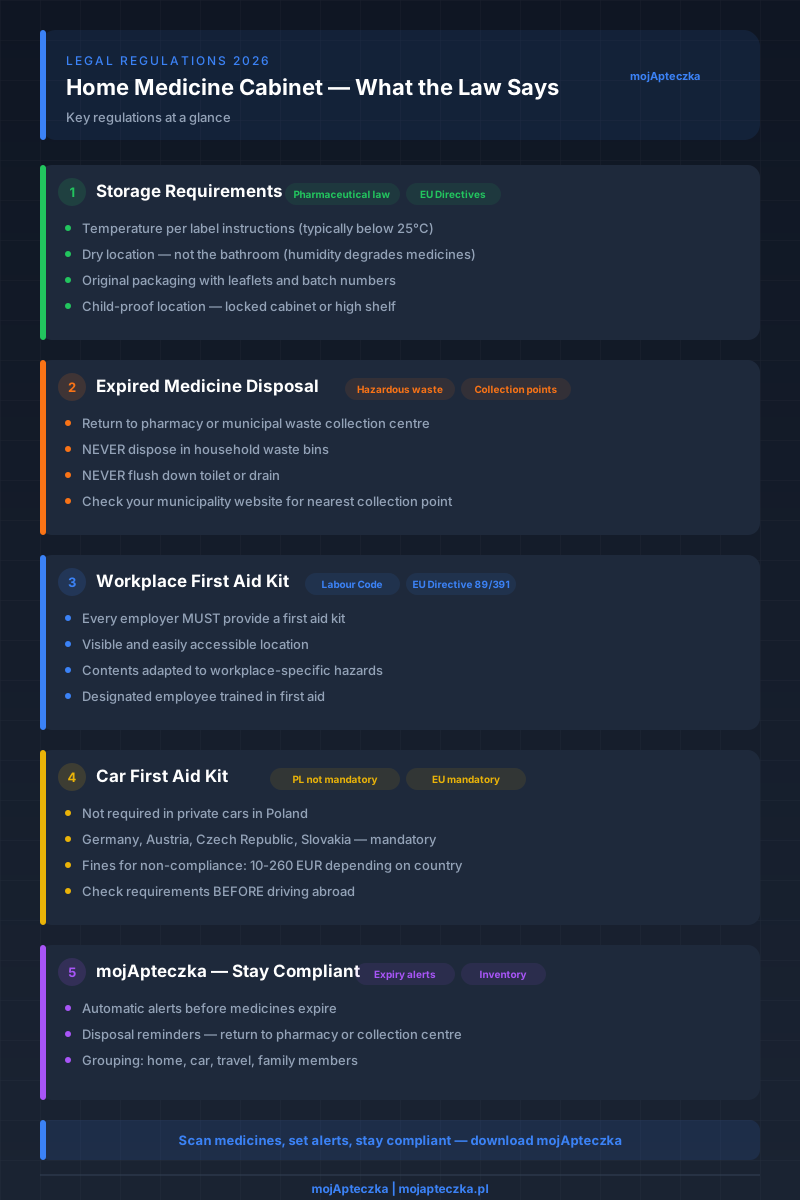
Most of us have some kind of home medicine cabinet. A bathroom drawer, a shelf in a kitchen cupboard, a box in the bedside cabinet. Inside there may be ibuprofen for headaches, plasters, perhaps nasal drops left over from last winter. And very few people stop to ask whether the way we store medicines at home is covered by any regulations.
The answer is less obvious than it may seem. Pharmaceutical law, the Labour Code, waste regulations and customs rules all touch, in some way, on medicines in your home, car, workplace or suitcase. You do not need to be a lawyer to know what you are doing well and what is worth changing. But it is worth knowing the basics.
This article reviews the most important regulations and good practices for a home medicine cabinet in 2026. The information is educational. In specific legal situations, it is always worth checking the original legislation or consulting a specialist.
Pharmaceutical Law — What It Says About Storing Medicines
The main legal act regulating the trade in medicinal products in Poland is the Pharmaceutical Law (Act of 6 September 2001 — Dz.U. 2001 No. 126 item 1381, as amended).
The act mainly applies to manufacturers, wholesalers, pharmacies and healthcare providers. You will not find a chapter titled “storing medicines at home”. But several of its provisions directly affect how you should handle medicines after buying them.
Storage Conditions on Packaging
Under current regulations, a medicine’s manufacturer must include storage conditions on the packaging. If the box says “store below 25°C” or “protect from light”, this is not a suggestion. It is the condition under which the manufacturer guarantees the medicine’s stability and effectiveness until the stated expiry date.
In practice, this means:
- Temperature matters. A bathroom where the temperature regularly rises above 25°C after a hot bath is not a good place for medicines. Nor is a kitchen spot next to the cooker.
- Humidity matters. The bathroom is the worst place in this respect, even though this is where many people keep their medicine cabinet.
- Light matters. Medicines in transparent packaging (drops, syrups) should not stand on a windowsill or on a shelf exposed to direct sunlight.
- Original packaging matters. Moving tablets into a generic container means losing information about the expiry date, batch number and storage conditions.
Over-the-Counter (OTC) Medicines vs Prescription Medicines (Rx)
Pharmaceutical law distinguishes between categories of medicinal product availability. From the perspective of a home medicine cabinet, one point matters most: prescription medicines were prescribed to a specific person for a specific condition. Giving them to other household members is not consistent with safe medicine use, even if the symptoms seem similar.
OTC medicines are intended for self-care, but that does not mean they can be treated casually. They also have storage conditions, expiry dates and restrictions on use described in the patient information leaflet included in the package.
Expired Medicines — Legal Obligations
Here the rules are clearer. Expired medicines are hazardous waste and are subject to separate waste management regulations.
What You Must Not Do
Under waste regulations (Act of 14 December 2012 on Waste — Dz.U. 2013 item 21):
- Do not throw medicines into the bin. Active ingredients can enter the environment from landfill sites.
- Do not flush medicines down the toilet or sink. Wastewater treatment plants are not designed to remove all pharmaceutical substances from water.
- Do not burn medicines in a domestic stove. Burning medicines can produce toxic compounds.
Where to Return Expired Medicines
Municipalities in Poland are required to organise systems for collecting expired medicines. In practice, this means you can return them to:
- Pharmacies — many pharmacies have special containers for expired medicines. Not every pharmacy accepts them, so it is worth asking in advance.
- Municipal Selective Waste Collection Points (PSZOK) — every municipality must operate at least one PSZOK that accepts hazardous waste, including medicines.
- Containers in offices, clinics and hospitals — some municipalities place additional collection points in public institutions.
You can find information about collection point locations in your municipality on the website of your municipal or city office.
For more on the practical side of disposing of expired medicines, see our guide: What to Do with Expired Medicines?.
How Many Expired Medicines Do You Have at Home?
Research suggests that the average Polish household contains anything from a few to a dozen or more packs of medicines past their expiry date. This is not necessarily neglect. It is a natural result of buying medicines “just in case” and not checking the medicine cabinet regularly.
If you want to understand the scale of the issue in your own home, see our article: How Many Expired Medicines Do You Have at Home?.
First Aid Kits at Work — Employer Obligations
Here the rules are clear and specific. If you are an employer, you must provide a first aid kit. If you are an employee, you have the right to know where it is.
Labour Code
Article 209¹ § 1 of the Labour Code states that an employer is required to:
provide the resources necessary for first aid in emergencies, firefighting and the evacuation of employees.
In practice, this means having a first aid kit, appointing someone responsible for restocking it, and training designated employees in first aid.
Regulation on General Occupational Health and Safety Rules
The Regulation of the Minister of Labour and Social Policy of 26 September 1997 on general occupational health and safety rules (§ 44) specifies that:
- First aid kits should be located in visible and easily accessible places.
- Their number and contents should be adapted to the type and level of hazards present in the workplace.
- First aid kits should be restocked regularly and include first aid instructions.
- A list of emergency telephone numbers should be displayed near the first aid kit.
The contents of a first aid kit are not defined by one universal list. They depend on the nature of the workplace. An office has different needs from a mechanical workshop, and a chemical laboratory has different needs again. The employer should agree the contents of the first aid kit with an occupational health physician.
What Are the Consequences of Not Having a First Aid Kit at Work?
Not having a first aid kit in the workplace is a breach of occupational health and safety rules and may result in:
- a fine from the National Labour Inspectorate,
- criminal liability if the lack of a first aid kit contributed to a worsening of the injured person’s condition after a workplace accident.
Car First Aid Kit — Requirements in Poland and the EU
Car first aid kits are an area where Polish and European rules differ significantly. It is worth knowing this, especially if you travel abroad by car.
Poland
In Poland, there is no statutory obligation to carry a first aid kit in a private passenger car. The Road Traffic Law requires a warning triangle and a high-visibility vest. It does not formally require a first aid kit.
However: company vehicles, buses, taxis and driving school vehicles are subject to separate rules that may require a first aid kit.
EU Countries Where a First Aid Kit Is Mandatory
If you travel abroad by car, the situation is completely different:
- Germany — first aid kit compliant with DIN 13164, fine around 10 EUR if missing.
- Austria — first aid kit mandatory (ONORM V 5101), fine up to 72 EUR.
- Czech Republic — mandatory, fine up to 2000 CZK.
- Slovakia — mandatory, fine up to 66 EUR.
- Croatia — mandatory, fine up to 260 EUR.
- Greece — mandatory, fine up to 150 EUR.
Before leaving, always check the current rules for your destination and transit countries. Requirements can change.
You can find the full car first aid kit guide here: Car First Aid Kit — Requirements 2026.
Children’s Access to Medicines — Parents’ Legal Responsibility
This topic connects civil law with home safety. Parents and legal guardians are responsible for the safety of children in their care.
What the Rules Say
The Family and Guardianship Code (Articles 95-96) places a duty on parents to care for their child’s safety. In the context of a home medicine cabinet, this means:
- Medicines should be stored out of children’s reach — high up, in a locked cabinet or in a container with a child-proof closure.
- Particular care is needed with prescription medicines, pleasant-tasting syrups and products a child might mistake for sweets.
- Cleaning and disinfecting products should be stored separately from medicines and also out of children’s reach.
Scale of the Problem
Medicine poisoning in children is one of the most common reasons for emergency department visits in the 1-5 age group. In most cases, the cause is easy access to medicines left within reach.
For more on medicine safety at home with children, see our article: Medicine Safety at Home — Guide.
Taking Medicines Abroad — Customs and Health Regulations
Travelling with medicines? Specific rules apply to transporting medicinal products both within and outside the EU.
Travel Within the EU
Within the European Union, you may carry medicines for personal use in quantities that match your needs for the trip — usually taken to mean up to 3 months. Key rules:
- Carry medicines in their original packaging with the name, composition and expiry date visible.
- For prescription medicines, take a copy of the prescription or a doctor’s certificate in English or in the language of the destination country.
- Psychotropic and narcotic medicines (for example, strong painkillers or ADHD medicines) require a special certificate based on the Schengen template, confirmed by the relevant national authority.
Travel Outside the EU
Rules may be much stricter:
- Some countries (for example, the United Arab Emirates, Japan and Singapore) have very restrictive rules on importing medicines that are available over the counter in Poland.
- Substances containing codeine, pseudoephedrine or benzodiazepines may be classified as narcotics in other countries.
- Before travelling, check the customs rules of the destination country and contact the embassy if you are unsure.
Medicines in Hand Luggage (Plane)
Under aviation security rules:
- Liquid medicines (syrups, drops) are subject to the 100 ml limit in hand luggage unless you have a medical certificate confirming that you need to use them.
- Tablets and capsules are not subject to quantity limits, but should be kept in their original packaging.
- Insulin, syringes and needles may be carried in hand luggage if you have a medical certificate.
Practical Checklist — How to Stay Compliant at Home
We have collected the key points in one list. Go through it and check how many you already meet:
Storage
- Medicines stored at the temperature recommended on the packaging (usually below 25°C).
- Medicine cabinet in a dry place — not in the bathroom.
- Medicines protected from direct sunlight.
- All medicines in their original packaging with patient information leaflets.
- Medicine cabinet in a place inaccessible to children — high up or in a locked cabinet.
- Prescription medicines stored separately, labelled with the name of the person they were prescribed for.
Expiry Dates
- Regular expiry date checks — at least twice a year.
- Expired medicines separated out and returned to a collection point (pharmacy, PSZOK).
- Opened medicines (syrups, eye drops) used within the time stated on the packaging after opening.
Disposal
- Expired medicines never go into the ordinary bin or down the toilet.
- You know where your nearest expired medicine collection point is.
- You sort empty medicine packaging (blisters, bottles) according to your local waste separation rules.
Car and Work First Aid Kits
- If you travel abroad by car — your car first aid kit meets the requirements of your destination countries.
- At work — you know where the first aid kit is.
- If you are an employer — the first aid kit is complete, accessible and restocked regularly.
Travel
- Prescription medicines are in their original packaging with a copy of the prescription.
- You have checked the customs rules of the destination country (especially for psychotropic medicines).
- You have a medical certificate for medicines that require special permission.
How mojApteczka Helps You Stay Compliant
Rules on medicines at home have one thing in common: control over what you have, what condition it is in, and when it expires. This is exactly where mojApteczka helps.
Expiry Date Alerts
The expiry date alerts feature sends notifications before a medicine expires. You do not need to remember to check manually — the app does it for you. And when a medicine expires, you receive a reminder to return it to a collection point.
Organised Inventory
With medicine grouping, you get a full picture of your medicine cabinet. You can create separate groups: home medicine cabinet, car first aid kit, travel kit, Anna’s medicines, grandad’s medicines. Everything is in one place, with full control over dates and contents.
Medicine Scanner
Instead of entering data by hand, scan the packaging. mojApteczka recognises the medicine and adds it to your inventory with information about the expiry date and storage conditions.
Family Sharing
If you care for your family — parents, children or a partner — you can share the medicine cabinet with other users. Everyone sees the current status and everyone receives alerts. No expired medicine goes unnoticed.
Frequently Asked Questions
Can I store prescription medicines belonging to someone else?
Formally, prescription medicines are prescribed to a specific person. Keeping them in a home medicine cabinet is common, but using medicines prescribed to someone else is not safe and is not consistent with the principles of pharmacotherapy. If you have medicines at home after a deceased family member, or medicines that nobody uses any more, return them to a collection point.
Does a home medicine cabinet need any kind of certificate?
No. There is no requirement to have a certified home medicine cabinet in a private home. The situation is different for first aid kits in workplaces or vehicles, where standards may apply (for example, DIN 13164 for a car first aid kit in Germany).
What about dietary supplements — are they covered by the same rules?
Dietary supplements are not medicinal products within the meaning of the Pharmaceutical Law. They are governed by food safety rules. Even so, it is worth storing them in similar conditions to medicines — in a dry, dark place, away from children, with expiry dates checked.
Can I be fined for storing medicines incorrectly at home?
In practice, there are no rules that impose fines for storing medicines in unsuitable conditions in a private home. Criminal provisions are more concerned with illegal trade in medicines, prescription fraud or running an illegal pharmacy. However, storing medicines incorrectly creates a real health risk — not because of a fine, but because of the risk of using a medicine that has lost effectiveness or changed properties.
Summary
The rules on medicines at home are not complicated, but there are more of them than most of us assume. From storage conditions set by the manufacturer, through the duty to dispose of medicines correctly, to requirements for first aid kits at work and in cars — these are all parts of one system aimed at safety.
You do not need to know every paragraph. It is enough to:
- Store medicines according to the instructions on the packaging.
- Check expiry dates regularly.
- Return expired medicines to a collection point.
- Keep medicines away from children.
- Check the rules on transporting medicines before you travel.
And if you want to keep all of this under control with little effort — mojApteczka can help. Scan, organise, set alerts. A few minutes now gives you peace of mind for the whole year. The app is available on Google Play.
This article is informational and educational. It does not constitute legal advice. In specific legal situations, we recommend consulting an appropriate specialist or referring to the original legal acts.
Read More
Sources
- Ustawa z dnia 6 września 2001 r. — Prawo farmaceutyczne (Dz.U. 2001 nr 126 poz. 1381)
- Ustawa z dnia 14 grudnia 2012 r. o odpadach (Dz.U. 2013 poz. 21)
- Ustawa z dnia 26 czerwca 1974 r. — Kodeks pracy (Dz.U. 1974 nr 24 poz. 141)
- Rozporządzenie MPiPS w sprawie ogólnych przepisów BHP (Dz.U. 1997 nr 129 poz. 844)
- Zrób porządek w apteczce — pacjent.gov.pl
Frequently asked questions
- Are there regulations in Poland on storing medicines at home?
- There is no direct law requiring a specific way of storing medicines in a private home. However, the Pharmaceutical Law (Dz.U. 2001 No. 126 item 1381) and its implementing regulations define storage conditions for medicinal products, and manufacturers include these conditions on packaging. Ignoring them may reduce a medicine's effectiveness and create a health risk.
- Where can you return expired medicines in Poland?
- Expired medicines should be returned to special containers in pharmacies, clinics, municipal offices or Municipal Selective Waste Collection Points (PSZOK). Under current rules, they must not be thrown into ordinary household waste or flushed down the toilet. You can find information about your nearest collection points on your municipality's website.
- Does an employer have to provide a first aid kit at work?
- Yes. The Labour Code (Article 209¹) requires every employer to provide first aid resources, including a first aid kit. The Regulation of the Minister of Labour and Social Policy on general occupational health and safety rules specifies that first aid kits should be placed in visible and easily accessible locations, and that their contents should match the hazards present in the workplace.
- What medicines can you take abroad in hand luggage?
- When travelling within the EU, you may carry medicines for personal use in quantities that match your needs for the trip (usually up to 3 months). Prescription medicines should be kept in their original packaging, ideally with a copy of the prescription or a doctor's certificate. When travelling outside the EU, rules may be stricter — some countries prohibit the import of certain substances. Always check the destination country's rules before you leave.