How to give medicine to your child safely — weight-based dosing
Learn how to calculate medicine doses for children by body weight, the most common mistakes parents make, and when to consult a doctor.
It is 2 in the morning. Your child is crying and has a temperature of 39°C. You reach for the paracetamol syrup and look at the leaflet. “Children aged 7 to 12: 5-10 ml.” But your child is 4 years old. Or perhaps they are 8, but weigh as much as a 12-year-old. How much should you give? How much is too much? And why is the dosage listed by age at all, when children of the same age can weigh twice as much as each other?
These are questions parents face every day. And the answers are not as simple as the leaflet suggests.
Why dosing in children is different from dosing in adults
A child is not a small adult. Their body processes medicines differently:
- Liver — in newborns and infants the liver enzymes are immature. Medicines are metabolised more slowly, which means they stay in the body longer and can reach higher concentrations.
- Kidneys — in young children renal filtration is lower. Medicines cleared by the kidneys persist for longer.
- Body composition — newborns have proportionally more water and less fat tissue than adults. This affects how a medicine is distributed throughout the body.
- Body surface area — the ratio of skin surface area to body mass is much greater in children than in adults. This influences how medicines are absorbed through the skin.
For these reasons, paediatric dosing is not a simple matter of giving “half the adult dose”. Every medicine has its own paediatric guidance, based on clinical studies involving children.
How to calculate the correct dose
There are two main approaches to dosing medicines in children:
Weight-based dosing (mg/kg)
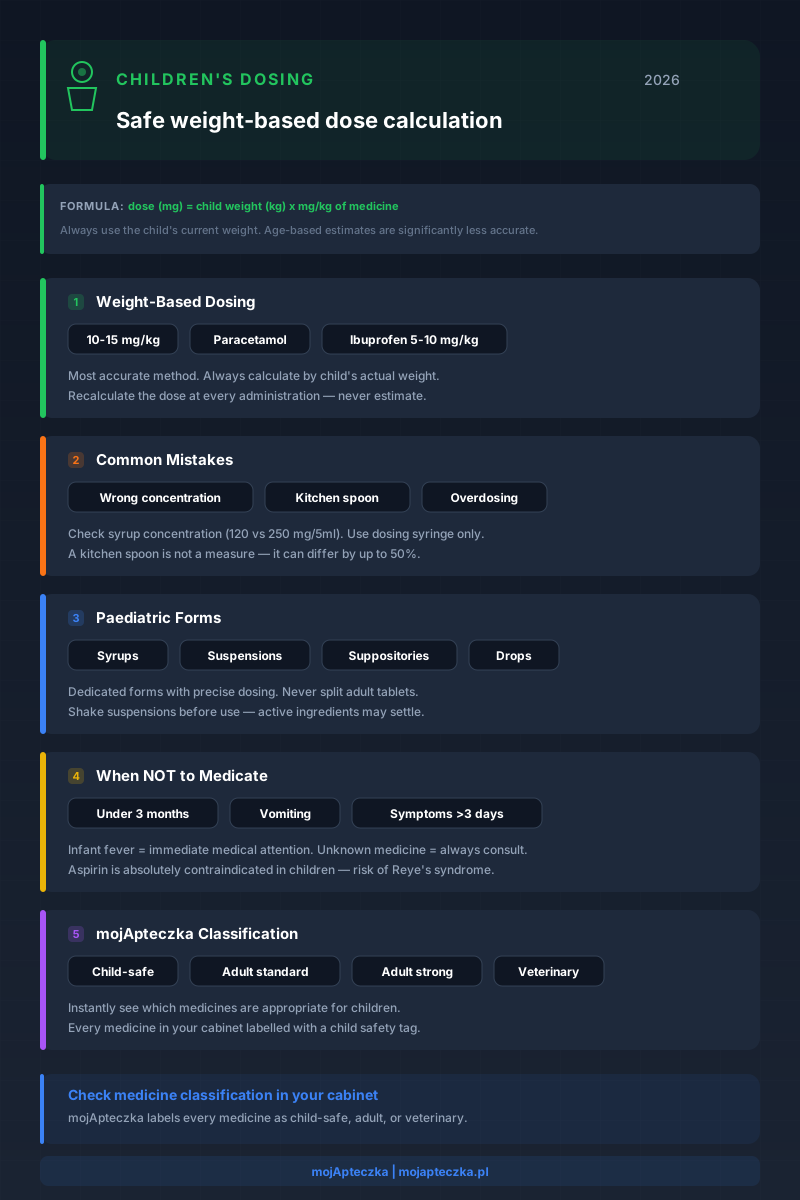
This is the most common and most accurate method. The dose is expressed as a number of milligrams of medicine per kilogram of the child’s body weight.
Example — paracetamol:
- Dose: 10-15 mg/kg/dose
- Child weighs 20 kg: 20 x 15 = 300 mg per dose
- Syrup at 120 mg/5 ml: 300 / 120 x 5 = 12.5 ml
Example — ibuprofen:
- Dose: 5-10 mg/kg/dose
- Child weighs 15 kg: 15 x 10 = 150 mg per dose
- Syrup at 100 mg/5 ml: 150 / 100 x 5 = 7.5 ml
Age-based dosing
Leaflets often list dosage by age bracket. This is convenient, but less precise, because children of the same age can have very different body weights. A 5-year-old may weigh 15 kg or 25 kg. A dose labelled “for children aged 4-6” may be too low for one child and too high for another.
Rule: if you know your child’s weight, dose by mg/kg. If you do not have scales to hand, use the age brackets on the leaflet as a guide.
The most common mistakes parents make
Mistake 1: Confusing product strengths
Paediatric syrups come in different strengths. Paracetamol may be available as 120 mg/5 ml or 250 mg/5 ml. If you calculate the dose for one strength and then give the other, you could give twice as much or half as much as intended.
Always check the strength on the packaging before measuring a dose.
Mistake 2: Using a kitchen spoon
A kitchen spoon is not a measuring device. Its capacity ranges from 2.5 ml to 7 ml, while “one teaspoon” in a leaflet means 5 ml. Use the dosing syringe or measuring cup supplied with the medicine. This is not pedantry; it is the difference between a therapeutic and a subtherapeutic dose.
Mistake 3: Dosing “generously” because the child is big for their age
“I give him a bit more because he is big for his age” — this is dangerous reasoning. Paediatric dosing is calculated with a safety margin. Exceeding the recommended dose does not produce a better effect; it only increases the risk of side effects.
Mistake 4: Combining preparations that contain the same active ingredient
This is the same problem as in adults, but more dangerous in children. A fever syrup (paracetamol) plus a cold syrup (which also contains paracetamol) equals a double dose of paracetamol. Always check the ingredients of every product.
Mistake 5: Giving children adult medicines
Adult tablets and capsules are not intended for children. You cannot split them into quarters and assume that this will give an appropriate dose. Dedicated paediatric forms — syrups, suspensions, suppositories, drops — exist for children and allow precise dosing.
When you should NEVER give medicine without consulting a doctor
There are situations where giving your child medicine without medical advice is risky:
- Newborns and infants under 3 months — fever in an infant is always a reason for immediate medical consultation.
- Vomiting — the child cannot take oral medicine. Suppositories or intravenous treatment (in hospital) may be needed.
- Symptoms lasting longer than 3 days — fever, pain, or cough that does not improve despite treatment.
- An unfamiliar medicine — do not give your child a medicine you do not know, even if someone recommends it.
- Antibiotics — never without a prescription. Antibiotic dosing in children is strictly defined and requires a medical diagnosis.
How mojApteczka helps parents
Paediatric classification in mojApteczka labels every medicine in your home medicine cabinet as:
- Children’s — safe and intended for children.
- Standard adult — for adults, not for children.
- Strong adult — a prescription medicine, definitely not for children.
- Veterinary — not for human use.
This means that at night, when your child has a fever, you can open the app and immediately see which medicines in your home medicine cabinet are suitable. You do not have to read every leaflet in the dark.
You can also check drug interactions — because if your child is taking an antibiotic and you want to give ibuprofen for a fever, it is worth knowing whether that combination is safe.
If you are looking for more information about managing medicines safely in a family with children, visit mojApteczka for parents. The Android app is also available on Google Play.
Medical disclaimer: This article is for informational and educational purposes only. It does not constitute medical advice and does not replace consultation with a doctor or pharmacist. Medicine dosing in children should always be discussed with a paediatrician or pharmacist. If in doubt, contact your doctor. In a life-threatening emergency, call 112.
Have questions or suggestions? Write to us: kontakt@mojapteczka.pl
Frequently asked questions
- How do I calculate a paracetamol dose for my child?
- Standard paracetamol dosing for children is 10-15 mg per kilogram of body weight, every 4-6 hours, up to 4 times daily. For a child weighing 15 kg, that is 150-225 mg per dose. Always check the strength of the product (for example, syrup 120 mg/5 ml versus 250 mg/5 ml) and measure it with a dosing syringe, not a kitchen spoon.
- Can I give my child half an adult tablet?
- This is not recommended without consulting a doctor or pharmacist. Adult tablets come in different strengths, and splitting them does not guarantee even distribution of the active ingredient. Dedicated paediatric forms (syrups, suspensions, suppositories) provide precise dosing.
- When should I NOT give medicine to a child without medical advice?
- Do not give medicine to babies under 3 months without medical advice (fever requires immediate medical attention), when the child is vomiting and cannot take oral medicine, when symptoms persist beyond 3 days, or when you are unsure about the dosage. If in doubt, always ask a doctor or pharmacist.
- How does mojApteczka help with children's medicine dosing?
- The paediatric classification feature in mojApteczka labels every medicine as children's medicine, standard adult, strong adult, or veterinary. This lets you immediately see which medicines in your home medicine cabinet are suitable for a child and which should not be given to them.