Polypharmacy — How to Safely Manage Multiple Medications for an Elderly Parent
You visit your mother on a Sunday afternoon and find eleven medicine boxes on the kitchen table, three different pill organisers (none fully filled), and a handwritten note from her cardiologist that contradicts what the neurologist told her last Tuesday. She takes her blood pressure tablet “when she remembers,” doubled her statin dose because “the first one wasn’t working,” and has been crushing a slow-release capsule because she struggles to swallow it whole.
This is not a hypothetical. This is polypharmacy in practice, and it is happening in millions of homes right now.
If you are the adult child of an ageing parent — or the caregiver for any elderly person taking multiple medications — this guide is for you. Not theory. Practical steps to reduce risk and bring order to a situation that can quietly become dangerous.
What Polypharmacy Actually Means
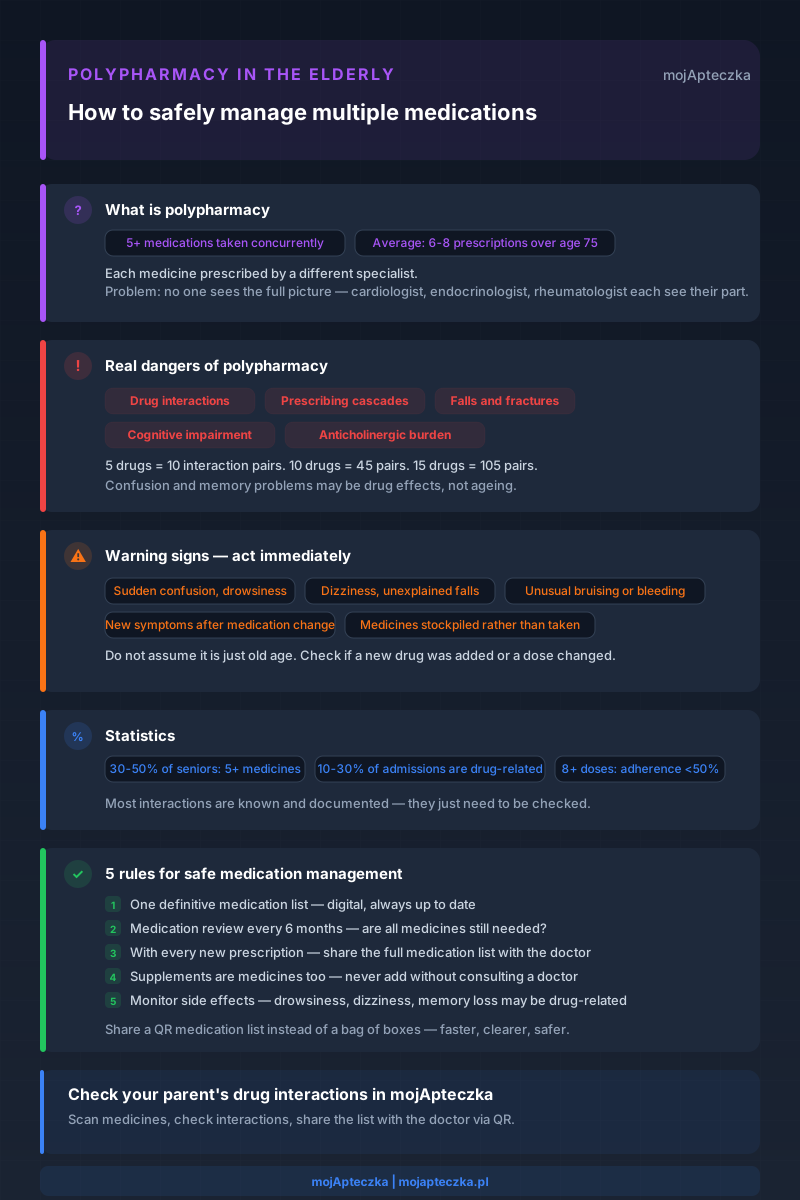
Polypharmacy is typically defined as the concurrent use of five or more medications. By some definitions, it starts at the point where the number of drugs increases the risk of adverse interactions and side effects beyond the benefit of treatment.
Among adults over 65, polypharmacy is remarkably common. Studies across Europe consistently show that 30 to 50 percent of older adults take five or more medicines daily. In care homes, that figure rises sharply — ten or more medications is routine.
The issue is not simply the number of medicines. It is what happens when multiple drugs interact inside a body that metabolises them more slowly than it did twenty years ago. Kidney function declines. Liver enzyme activity changes. Body composition shifts. A dose that was appropriate at sixty-five may be excessive at eighty.
The Real Risks — What Goes Wrong
Polypharmacy does not just create theoretical risks. It creates measurable, everyday problems.
Drug-drug interactions are the most obvious concern. Blood thinners combined with certain painkillers increase bleeding risk. Some heart medications interact with common antibiotics. Drugs that individually cause mild drowsiness can combine to produce dangerous sedation.
Adverse drug reactions account for a significant proportion of hospital admissions among the elderly. Many of these are predictable and preventable. A 2020 meta-analysis estimated that adverse drug reactions cause 10 to 30 percent of hospital admissions in patients over 65.
Prescribing cascades occur when a side effect of one drug is mistaken for a new condition, leading to another prescription. Blood pressure medication causes ankle swelling; a diuretic is added; the diuretic causes gout; a gout medication is prescribed. The original list grows, and each addition brings new risk.
Non-adherence rises with complexity. The more medicines a person takes, the more likely they are to skip doses, take the wrong dose, or abandon a medication entirely. Regimens involving eight or more daily doses have adherence rates below 50 percent in many studies.
Falls and cognitive decline are linked to polypharmacy independently of the individual drugs involved. The cumulative anticholinergic and sedative burden of multiple medications is a recognised risk factor for falls, confusion, and accelerated cognitive decline in older adults.
How to Organise the Chaos
Bringing order to a polypharmacy situation requires a systematic approach. Here is where to start.
Create one definitive medication list. This sounds simple. It is not. Many elderly patients see multiple specialists, each prescribing independently. The GP may not know what the hospital consultant added. Gather every box, bottle, and blister pack in the house. Include over-the-counter products, vitamins, supplements, and herbal remedies. Write down every single one — name, dose, frequency, and prescribing doctor.
Request a medication review. In many healthcare systems, elderly patients taking five or more medicines are entitled to a structured medication review with their GP or a clinical pharmacist. This is not a casual chat — it is a systematic assessment of whether each medicine is still necessary, whether doses are appropriate, and whether anything can be safely stopped. Ask for one. Push for one.
Simplify the regimen where possible. Can twice-daily doses be switched to once-daily alternatives? Can two separate medicines be replaced by a single combination tablet? Can a medicine that was started for a temporary problem be stopped now that the problem has resolved? Every reduction in complexity improves adherence and reduces risk.
Use a single pharmacy. When all prescriptions go through one pharmacy, the pharmacist’s software can flag interactions across the entire medication list. Split prescriptions across multiple pharmacies, and this safety net disappears.
Checking Drug-Drug Interactions
One of the most dangerous aspects of polypharmacy is the interaction web. With five medications, there are ten possible two-drug interactions. With ten medications, there are forty-five. With fifteen, there are one hundred and five.
No one can keep that many interactions in their head. Digital tools exist for exactly this reason.
mojApteczka’s drug interaction checker lets you input your parent’s full medication list and identify potential interactions between any of them. It flags severity levels so you can distinguish between interactions that require immediate attention and those that simply need monitoring. This is not a replacement for a pharmacist’s review — it is a way to come prepared with the right questions.
The Caregiver’s Role — And mojApteczka’s Caregiver Features
If you are managing your parent’s medications remotely — perhaps you live in a different city, perhaps you visit once a week — you need visibility into what is actually happening between visits.
mojApteczka’s caregiver and ward system allows you to manage your parent’s medicine cabinet from your own account. You can see their full medication list, receive expiry alerts on their behalf, and ensure that changes made at a doctor’s appointment are reflected in the digital record immediately.
This is not about control. It is about having a shared, accurate source of truth that both of you — and any other family members involved in care — can rely on.
When your parent sees a new specialist, they can share their complete, current medication list instantly using the QR code sharing feature. No more handwritten lists with illegible names. No more forgotten medicines. The doctor sees everything — including OTC products and supplements that patients often forget to mention.
Five Practical Tips for Caregivers
1. Attend medical appointments when possible. Elderly patients often underreport symptoms, forget to mention new medications, or misunderstand instructions. Your presence as a second pair of ears — and someone who can ask follow-up questions — materially improves outcomes. If you cannot attend in person, ask to join by phone.
2. Watch for new symptoms after any medication change. When a new drug is added or a dose is changed, be alert for anything unusual in the following two weeks. New dizziness, confusion, appetite changes, sleep disruption, or mood shifts may be drug-related. Report them early.
3. Never adjust doses without medical guidance. “Half a tablet might be enough” is not a safe assumption. Some tablets cannot be split. Some drugs have non-linear dose responses. Some require gradual tapering, not abrupt changes. Always ask a pharmacist or doctor first.
4. Set up a proper medication schedule. A weekly pill organiser, filled once a week at the same time, reduces daily decision-making. If the regimen is complex, create a written schedule with times, drug names, and whether to take with food. Post it on the fridge.
5. Review the list every six months. Medication lists drift. Temporary prescriptions become permanent by inertia. Supplements get added and never re-evaluated. Set a calendar reminder to review the entire list with the GP at least twice a year.
When to Raise the Alarm
Certain situations with polypharmacy require prompt action, not a wait-and-see approach:
- A sudden change in mental state — confusion, agitation, drowsiness — after a medication change
- A fall, particularly if there was no obvious environmental cause
- Signs of bleeding — unusual bruising, blood in urine or stool — in anyone taking blood thinners
- Refusal to take medications or evidence that medicines are being stockpiled rather than taken
- A new prescription from a specialist who was not aware of the full medication list
Bringing It All Together
Polypharmacy is not a failure of medicine. It is a consequence of living longer with multiple chronic conditions, each of which genuinely benefits from treatment. The goal is not to eliminate all medicines — it is to ensure that every medicine your parent takes is still needed, is dosed correctly, is not dangerously interacting with another drug, and is actually being taken as prescribed.
That requires a system. Not just goodwill, not just memory, not just hope.
Start building that system today at mojapteczka.pl. You can also download the Android app from Google Play.