How Much Money Are You Wasting on Medicines You Already Have? A Savings Guide
Buying medicines that are already sitting in your drawer? The average family wastes 50-200 PLN a year on duplicates. See how to stop overpaying.
A scene you know all too well
You are standing in the pharmacy. Your child has been coughing for three days, so you ask for cough syrup, ibuprofen just in case, and plasters because you have run out at home. You pay 67 PLN. You get home, open the bathroom drawer and see: two packs of ibuprofen (one still unopened), cough syrup bought a month ago, and a full box of plasters pushed behind the vitamins.
Do you know that feeling? That mix of irritation and resignation - “not again”.
Now multiply that by four or five moments like this in a year. Add the medicines you throw away every so often because they expired before anyone used them. The bill becomes surprisingly high.
Numbers that hurt more than a headache
Before you think, “fine, but it is only a few zlotys” - let us look at the data.
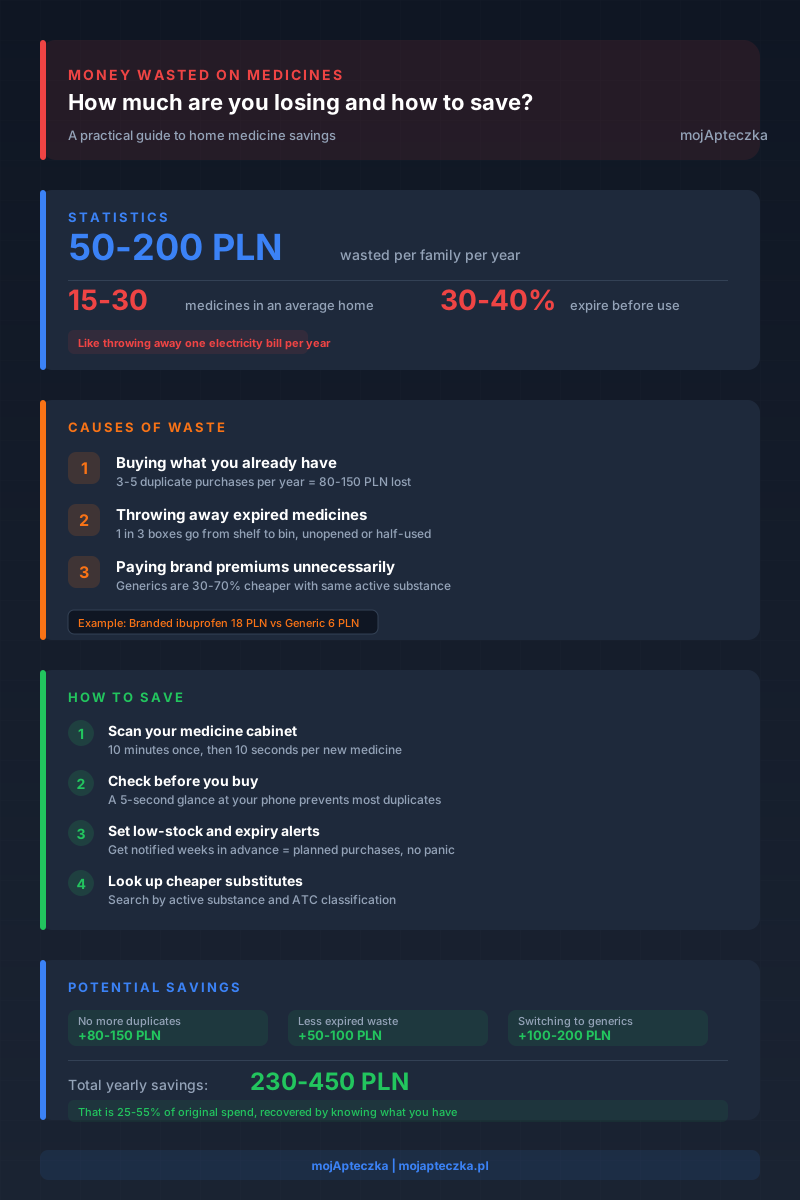
The average Polish household has between 15 and 30 different medicines and dietary supplements at home. Some are in the bathroom cabinet, some in a kitchen drawer, some in the car first aid kit, and some in the travel bag you forgot about three holidays ago.
Studies on how households manage medicines show that 30-40% of those medicines are expired. Not because anyone is careless - simply because nobody can keep a dozen different expiry dates in their head.
And now the key number: the average Polish family wastes between 50 and 200 PLN a year on medicines they buy unnecessarily or throw away because they have expired. It is like throwing one electricity bill in the bin every year.
For families with young children (and therefore more frequent infections, faster turnover of syrups, and more stressful shopping trips), that amount can be higher.
Three ways you burn through money at the pharmacy
1. You buy what you already have
This is the most common scenario. You are standing in the pharmacy, you cannot remember whether the ibuprofen at home has run out, so you buy it “just in case”. Or the doctor prescribes an ointment, and you do not check whether you still have the same one from the previous prescription.
The problem is not that you have a poor memory. The problem is that nobody has a good memory for the contents of a medicine drawer. You keep a grocery list in your head (and you probably use an app anyway), but medicines? You buy those reactively - in the moment, under stress, in a hurry.
The result: 2-4 packs of the same medicines, half of which expire before you use them.
2. You throw away medicines that expired in the drawer
Once a year (or once every three years, if we are honest), you do a big clean-out of the home medicine cabinet. You take everything out, check the dates and realise that 5-8 packs are only fit to be thrown away. Syrup opened last year, tablets dated two years ago, an ointment nobody has used since the move.
That is money you spent in good faith, but it literally ends up in the bin (or rather, it should end up at the pharmacy - medicines should only be returned to collection points, not put in household rubbish).
If you knew three months before expiry that you had an unused medicine, you could still use it or give it to someone who needed it.
3. You pay for a brand when a substitute costs half as much
This is a more subtle money leak. You buy Nurofen for 25 PLN, while a generic ibuprofen with the same dose, the same active ingredient and made to the same standards costs 8-12 PLN.
Generic medicines undergo the same bioequivalence tests. They have the same active ingredient in the same dose. The difference is the packaging, the name and the price. And that difference can be 30-70% in favour of the generic.
This is not about always buying the cheapest option - sometimes the medicine form (for example soluble tablets versus regular tablets) matters for comfort. But it is worth at least knowing that an alternative exists before you pay full price.
How to stop overpaying - a concrete plan
Scan what you have at home
The first step is knowledge. You cannot save money on what you do not control. Take your phone, open mojApteczka and scan the medicine packs you have at home. AI recognition reads the name, dose, expiry date and quantity - you do not need to type anything in manually.
Yes, it takes 20-30 minutes the first time. But you do it once. After that, you update things as you go - you buy a new medicine, scan the pack, and it takes 10 seconds.
After that one review, you have the full picture on your phone: what you have, how much you have, and when it expires. That knowledge changes everything.
Check your medicine cabinet before you go to the pharmacy
Now that your inventory is scanned, the shopping dynamic changes. Standing in the pharmacy queue? You open the app and see: ibuprofen - 2 packs, valid until August. You do not buy it.
The doctor prescribes an ointment with a specific active ingredient? You check whether you have something with the same ingredient. You do - you leave the prescription for later.
This does not require discipline or willpower. It only requires one habit: pharmacy = open the app. A few seconds, dozens of zlotys saved.
Set low-stock alerts
How do you know ibuprofen is running low before it runs out completely (and before you buy it in a panic at an inflated price from a night pharmacy)?
Low-stock medicine alerts in mojApteczka solve this problem. You set a threshold - for example, “notify me when fewer than 5 tablets remain” - and you get a notification at a calm moment, when you can plan the purchase. You buy when you want to, not when you have to.
Search for substitutes by active ingredient
When a doctor prescribes a medicine or a pharmacist recommends something for your symptoms, check whether there is a cheaper equivalent. Substitute search in mojApteczka lets you find medicines with the same active ingredient, categorised by ATC classification. You can see the active ingredient, the dose and the available alternatives.
You do not need to be a pharmacist to use it. The app does the heavy lifting for you - you make an informed decision.
How much can you really save? Let us calculate it.
Take a family of four - two adults and two school-age children.
Duplicate purchases eliminated thanks to an up-to-date inventory: Suppose you avoid 4-5 unnecessary purchases a year, averaging 15-20 PLN each. That is 60-100 PLN a year.
Medicines saved from expiring thanks to alerts: If notifications help you use 3-4 medicines that would previously have ended up in the bin, you save another 30-60 PLN.
Switching to generics where possible: With 6-8 purchases a year where the difference between the brand and the generic is 10-15 PLN, you save 60-120 PLN.
Total: 150-280 PLN a year. This is not an abstract number. It is a new set of books for a child, a family trip to the cinema, or a month of internet.
And all you need to do is scan your home medicine cabinet once and build one habit: check your phone before buying.
A quarterly medicine cabinet audit - 15 minutes that pays back
Alongside ongoing tracking, it is worth doing a quick review once a quarter. The beginning of January, April, July and October - choose your dates and set a reminder.
The review looks like this: you open mojApteczka and check what is marked in red (expired) and orange (expiring soon). You take expired medicines to the pharmacy at the next opportunity. For medicines with short expiry dates, you plan to use them or make a note not to buy new ones.
15 minutes. Once every three months. That is the whole effort that separates a chaotic home medicine cabinet from one that is under control.
Stop paying for drawer chaos
Nobody likes throwing money away. And yet we do it regularly - buying medicines we already have, ignoring cheaper substitutes, and letting packs expire in forgotten drawers.
The solution does not require a revolution. It requires one tool, one review and one habit.
Go to mojapteczka.pl, scan your home medicine cabinet and see how many medicines you already have - and how much money you can stop wasting. The Android app is also available on Google Play.
Have questions about saving money on medicines? Write to us at: kontakt@mojapteczka.pl
Frequently asked questions
- How much does a family waste on unnecessary medicines each year?
- The average Polish family wastes between 50 and 200 PLN a year on duplicate purchases - medicines bought at the pharmacy that are already at home. On top of that are medicines thrown away after they expire because nobody knew they had them.
- How can I check what I have in my medicine cabinet before going to the pharmacy?
- Open the mojApteczka app on your phone - you can see a full list of medicines with their dosage, expiry dates and quantities. You can check it in the pharmacy queue in a few seconds.
- Are medicine substitutes really cheaper?
- Yes - generic medicines with the same active ingredient can be 30-70% cheaper than brand-name equivalents. mojApteczka lets you search for substitutes by ATC classification.
- How can I track which medicines are running low?
- mojApteczka on your phone sends notifications about low medicine stock and upcoming expiry dates. You can plan purchases before you run out of important medicines.