How Much Money Are You Wasting on Medicines You Already Have?
You are standing in the pharmacy queue after a doctor’s visit. The prescription says ibuprofen 400 mg, 20 tablets. You pay, take the bag, drive home, open the medicine cabinet to put it away — and there, on the second shelf, sits an unopened box of ibuprofen 400 mg, 20 tablets, with an expiry date eight months from now. You just spent 15 PLN on something you already had.
This happens more often than most people admit. Not because they are careless, but because no normal person maintains a mental inventory of every medicine in their home. You forget what you have, you buy it again, and the duplicate sits in the drawer until one of them expires and gets thrown away. It is a small waste each time. Over a year, across a whole household, it adds up to something surprisingly large.
The Numbers Behind Medicine Waste
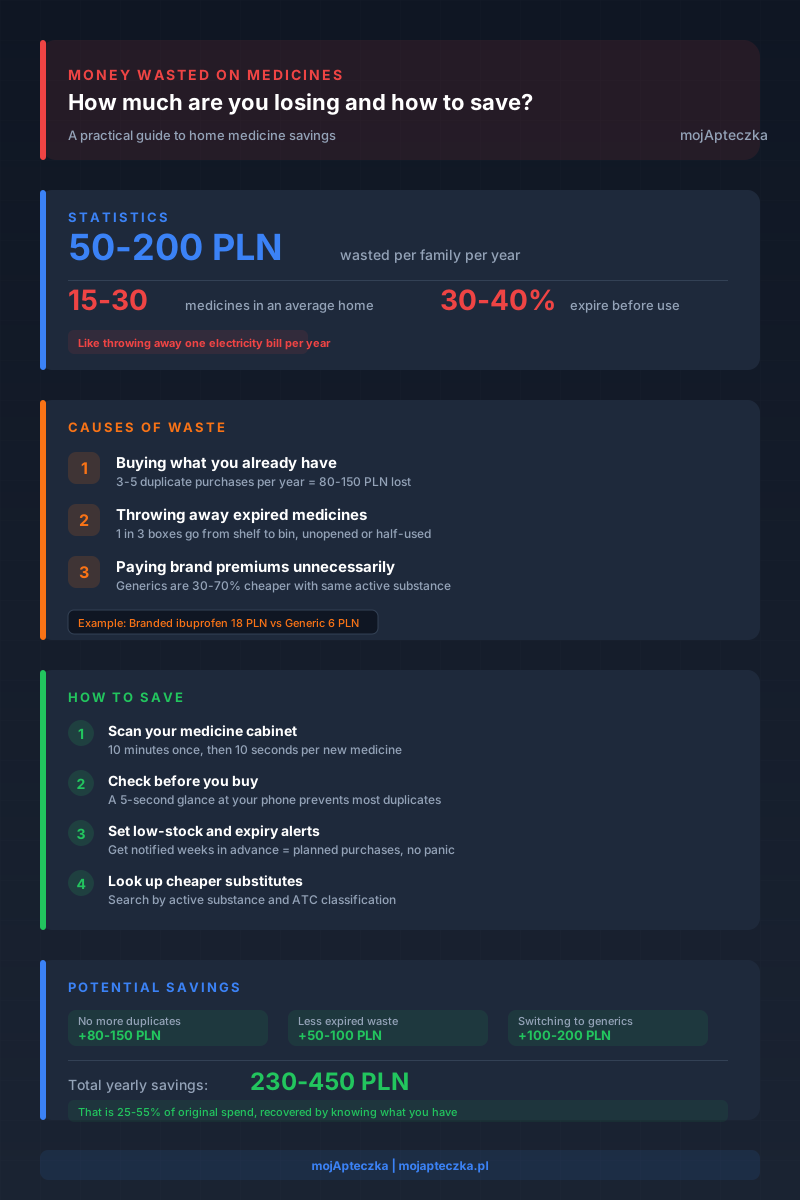
The average Polish household keeps between 15 and 30 different medicines at any given time. Some are prescription leftovers. Some are over-the-counter purchases from the last cold season. Some have been sitting in the cabinet for so long that nobody remembers buying them.
Studies and pharmacy surveys consistently show that 30 to 40 percent of home medicines expire before they are used. That is roughly one in three boxes going straight from the shelf to the bin, unopened or half-used.
When you add up duplicate purchases and expired waste, the average family loses somewhere between 50 and 200 PLN per year — roughly 12 to 50 euros — on medicines that served no purpose. For families managing chronic conditions, or households with children where medicine needs change frequently, the figure can be higher.
This is not money lost to a complex financial problem. It is money lost to a simple information gap: you do not know what you have, so you buy what you do not need, and what you already have goes to waste.
Three Ways You Are Losing Money
The waste breaks down into three distinct patterns, each with its own cause and its own fix.
1. Duplicate purchases
This is the pharmacy queue scenario. You need a medicine, you are not sure whether you have it at home, and the safe bet is to buy it. Sometimes the doctor prescribes something and you fill the prescription reflexively, without checking whether an identical product is already in your cabinet.
The most commonly duplicated medicines are the everyday staples: paracetamol, ibuprofen, antihistamines, nasal sprays, throat lozenges, and stomach remedies. These are cheap individually — 8 to 25 PLN per box — which is exactly why the waste goes unnoticed. Nobody tracks a 12 PLN purchase of paracetamol. But buy it three times a year when you only needed it once, and across five or six commonly duplicated products, you are losing 80 to 150 PLN annually without realising it.
2. Expired medicine waste
Every medicine that expires unused represents a purchase that delivered no value. The money was spent months or years ago, so it does not feel like a current loss — but it is.
The medicines most likely to expire are the ones bought for a specific situation that passed: antibiotics left over after a course was completed early (which, for the record, is itself a problem), cold remedies purchased in November and forgotten by spring, prescription painkillers from a dental procedure last year.
Liquid medicines are particularly vulnerable. A children’s fever syrup, once opened, typically has a shelf life of six months regardless of the printed expiry date. If your child does not get sick again within that window, the remainder is wasted. Eye drops expire 28 days after opening. Nasal sprays vary but rarely last longer than a few months once the seal is broken.
The silent part of this waste is that you do not just lose the product. You also face an unexpected repurchase when you need the medicine again and discover the old one has expired. You end up buying the same thing twice: once when you did not use it, and once when you finally need it.
3. Paying brand premiums unnecessarily
This is less about waste and more about overspending. The pharmacy shelf is full of products that contain the same active substance at the same dose, manufactured to the same regulatory standards, but sold under different names at vastly different prices.
A branded ibuprofen product might cost 18 PLN. A generic equivalent — same substance, same dose, same form — might cost 6 PLN. The difference is the brand name on the box and the marketing budget behind it. Both products passed the same regulatory approval process. Both contain the same active ingredient in the same quantity. The generic is not a lesser product.
Across all the medicines in a typical household, switching from branded to generic equivalents where possible can save 30 to 70 percent on individual products. Over a year, for a family that uses medicines regularly, this translates to real money — often more than the duplicate and expiry waste combined.
The obstacle is not willingness. Most people are happy to buy a cheaper generic if they know it exists. The obstacle is information: you need to know the active substance name, the ATC classification, and which alternatives are available. That takes effort at the pharmacy counter, and most people default to what they recognise.
How to Stop the Bleeding
Each of these three waste patterns has a practical solution. None of them require medical knowledge or unusual discipline. They require information — the right information, at the right moment.
Scan your cabinet once and know what you have
The foundation of everything else is a current inventory. If you know what medicines you have at home — names, doses, quantities, expiry dates — the duplicate purchase problem vanishes overnight. You check before you buy, and you only buy what you actually need.
mojApteczka lets you build this inventory by scanning each medicine box with your phone camera. The AI reads the package, identifies the product, and records the details automatically. A full cabinet of 20 medicines takes about ten minutes to scan. After that, your inventory is always in your pocket. Learn more about how the recognition works at AI medicine recognition.
The critical moment is not at home. It is at the pharmacy, when you are about to pay. A five-second glance at your phone tells you whether you already have the medicine. That single check prevents most duplicate purchases.
Set low-stock and expiry alerts
Knowing what you have is the first step. Knowing when something is running out or about to expire is the second. mojApteczka tracks quantities and expiry dates and sends notifications before you hit zero or before a medicine passes its use-by date.
This solves two problems at once. You stop being surprised by empty boxes when you need something urgently, and you stop discovering expired medicines when it is too late. Instead, you get a calm notification a few weeks in advance: “Children’s ibuprofen syrup expires in 30 days. 40 ml remaining.” That gives you time to use it or replace it on your next pharmacy visit, not in a panic at midnight. See how low-stock alerts work at low stock alerts.
Look up cheaper substitutes before you buy
When a doctor prescribes a medicine or you decide to buy something over the counter, the price you pay depends on which specific product you choose — and most people choose whatever name they recognise or whatever the pharmacist puts on the counter first.
mojApteczka includes a substitute search based on ATC classification. You enter the medicine you have been prescribed or want to buy, and the app shows you other products with the same active substance. You can see the alternatives before you reach the pharmacy, and you can ask the pharmacist for the one that fits your budget. This is not about cutting corners on health. It is about making an informed choice between identical products at different prices. Explore how substitute search works at medicine substitutes.
A Simple Savings Calculation
Take a household that currently spends 800 PLN per year on medicines — a realistic figure for a family of four with no major chronic conditions.
- Eliminating duplicate purchases saves roughly 80-150 PLN. That is the cost of buying things you already have, three to five times a year.
- Reducing expired waste saves another 50-100 PLN. That is the value of medicines thrown away because nobody tracked their dates.
- Switching to generics where possible saves 100-200 PLN. That is the brand premium on products where a cheaper equivalent exists.
Total potential savings: 230 to 450 PLN per year. That is 25 to 55 percent of the original spend, recovered by knowing what you have, when it expires, and what alternatives cost less.
For families managing chronic conditions with higher medicine budgets, the absolute savings are proportionally larger. The percentages hold.
What This Is Really About
Nobody becomes financially distressed because they bought one extra box of paracetamol. The individual amounts are small. But the pattern is a symptom of a bigger issue: most households manage their medicines with no system at all. Boxes go in, boxes come out, and the space in between is a black hole of forgotten purchases, missed expiry dates, and wasted money.
The money matters. But so does the frustration of discovering at 11 PM that the medicine you need expired last month, or realising in the pharmacy that you have no idea whether you already have what the doctor just prescribed. These are friction points in daily life that do not need to exist.
A simple inventory — maintained digitally, checked before purchases, monitored for expiry and stock — eliminates almost all of them. It is not a complicated system. It is a list on your phone that stays current.
Start building yours today at mojapteczka.pl. Scan your medicine cabinet, set up your alerts, and stop paying for medicines that are already sitting in your drawer. You can also download the Android app from Google Play.