Medicine Dispensing at Home — Track Every Dose Without Guesswork
It is Tuesday morning. You think you gave your father his blood pressure tablet with breakfast. Your mother thinks she did too. By Wednesday, the box has two fewer tablets than it should, and no one is certain who took what or when.
This is not carelessness. It is the natural result of managing medicines without a shared record. When more than one person is involved — two parents looking after a child, an adult child caring for an elderly parent, a couple managing each other’s prescriptions — the absence of a dispense log is a structural problem waiting to cause a real error.
The Quick Dispense feature in mojApteczka solves this with a single tap.
Why Tracking Dispensed Doses Matters
Double dosing is more common than you think
A study published in the journal Pediatrics found that double dosing of paediatric fever medicines occurs in a significant proportion of households where two caregivers are involved. The scenario is consistent: each person assumes the other has not yet given the medicine. Neither checks. Both give it.
For paracetamol in children, a double dose from two caring parents is often the source of the overdose — not neglect, but the absence of a shared log.
Under-dosing is just as consequential
Missing a dose of an antibiotic, an antiepileptic, or a cardiac medicine is not trivial. These drugs rely on maintaining consistent concentrations in the bloodstream. Every missed dose disrupts that consistency. Chronic under-dosing of antihypertensives, for example, carries a measurable increase in cardiovascular risk.
Doctors need real adherence data
“Are you taking your medicines as prescribed?” is a question asked at almost every GP or specialist appointment. The honest answer for most people is “I think so.” With a dispense history in an app, the honest answer becomes a screen showing exactly which doses were taken, at what time, and which were missed.
That difference in data quality changes the consultation. A doctor who can see that a patient skips the midday dose consistently can adjust the prescription to a twice-daily formulation. Without the data, that optimisation never happens.
How the Dispense Feature Works
One tap from the medicine card
The dispense flow starts from the medicine inventory. Every medicine card has a dispense button — no navigation through menus, no searching through settings. One tap opens the dispensing panel.
This is intentional. The design assumes you are using it in real conditions: a crying child at midnight, a rushed morning before work, handing medicine to an elderly parent over the phone while talking them through it. The fewer taps, the more reliably it gets done.
A stepper that handles fractional doses
Whole tablets are the easy case. The complex one is when the prescription says “half a tablet twice daily” — a genuinely common instruction for cardiological, neurological, and paediatric medicines. Or when a liquid medicine is dosed at 7.5 ml for a child of a specific weight.
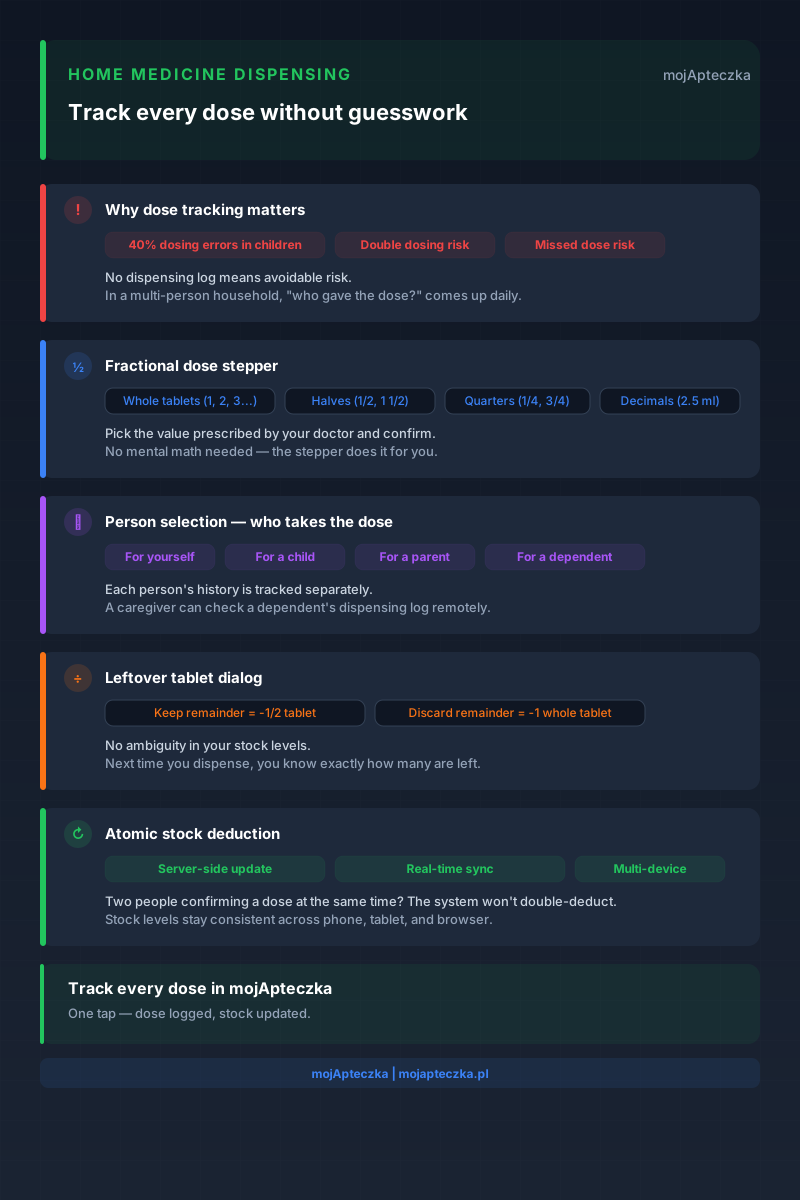
The dose stepper in mojApteczka covers:
- Whole units (1, 2, 3 tablets or capsules)
- Halves (½, 1½, 2½ tablets)
- Quarters (¼, ¾, 1¼ tablets)
- Decimal values for liquids, syrups, and powders (e.g. 2.5 ml, 7.5 ml, 10 ml)
No mental arithmetic. No estimating. You dial in the prescribed dose and confirm.
Who is taking it — the person picker
mojApteczka is built for households, not just individuals. One app can hold medicines for every family member. When you dispense, you select who is taking it: yourself, your child, your parent, your partner.
Each person has their own dispense history. If you are a caregiver looking after an elderly parent who does not use a smartphone, you can log doses on their behalf from your device. The history is tagged to them, not to you.
This integrates with the caregiver role, where a designated caregiver can see the full dispense history for each dependent and receive notifications if a scheduled dose is not confirmed.
The “kept rest / threw it away” dialogue
When you dispense half a tablet, the other half exists. What happens to it matters for stock accuracy. Some tablet formulations are stable when stored cut — others are not (enteric-coated tablets, for example, should generally not be split). But regardless of stability, the stock impact differs:
- Kept the other half — stock decreases by ½ tablet
- Threw it away — stock decreases by 1 whole tablet
mojApteczka asks explicitly after every fractional dispense. One tap to answer. No ambiguity in the inventory from that point forward.
Atomic stock deduction
Every confirmed dispense triggers an immediate, server-side stock update. The operation is designed to be atomic — if two family members simultaneously confirm a dose from two different phones (it happens when two parents both give medicine to a child), the server will process both correctly without double-counting the deduction.
Stock is consistent across the web app, iOS, and Android at all times.
Real Scenarios Where This Feature Changes Outcomes
The fever at 3 AM
Your child wakes with a temperature of 39.8°C. You give ibuprofen — 7.5 ml at the prescribed weight-based dose. You log it in the app: 7.5 ml, for your child. Four hours later, your partner gets up, checks the app, and sees the dose was given at 3:14 AM. They know not to give another dose yet. No phone call. No waking you up to ask. No guessing.
The elderly parent on multiple medicines
Your mother takes five medicines in the morning and two in the evening. She lives alone but you visit several times a week. On the days you are not there, she manages independently. The caregiver role lets you check remotely whether she has confirmed her morning doses. If she has not by 10 AM, you get a notification and can call her.
The “as needed” prescription
Some medicines — painkillers, antihistamines, medicines for nausea — are taken as needed rather than on a schedule. Without a log, it is easy to lose track of how many you have taken today. The low stock alert alongside the dispense history gives you the full picture: how many doses you have taken today, and how many tablets remain in the box.
The handover between carers
If a nurse, a visiting relative, or a home help assistant gives a medicine, they can log it in the app on behalf of the person receiving it. Everyone with access to the shared cabinet sees the updated history. The next carer does not have to ask whether the last dose was given.
How Dispensing Fits Into the Broader System
Quick Dispense is one part of mojApteczka’s interconnected feature set:
| Feature | How it connects to dispensing |
|---|---|
| Reminders | Notify you when a dose is due; confirming a reminder logs the dispense automatically |
| Low stock alerts | Each confirmed dispense reduces stock; you get notified before you run out |
| Caregiver role | Caregivers see dispense history and receive alerts for missed doses |
| Shared medicine cabinet | All household members see current stock and dispense history |
| Notes | Add context to a dispense: “taken with food”, “half dose due to side effects” |
| AI medicine recognition | Scan a new box to add it to inventory; then dispense from day one |
Getting Started
The dispense feature requires no setup beyond adding a medicine to your inventory. The fastest way to do that is with the AI scanner: point your camera at the box and the app identifies the medicine, form, and pack size automatically.
Once a medicine is in your inventory, you are ready to dispense:
- Open the mojApteczka app or go to mojapteczka.pl
- Tap the medicine in your inventory
- Tap the dispense button on the medicine card
- Set the dose using the stepper
- Select who is taking it
- Confirm — and if it was a fractional dose, tell the app what you did with the rest
- Done — stock updated, dispense logged, history current
The Difference One Feature Makes
Home medicine management tends to get treated as a solved problem — people have been taking pills for decades, after all. But the reality is that dosing errors, missed doses, double dispensing, and stock surprises are common in almost every household that manages more than one or two medicines.
Quick Dispense addresses these problems at the point where they actually occur: the moment someone takes a medicine. With fractional dose support, a person picker, a handled leftover dialogue, and server-side atomic stock deduction, that moment becomes reliable rather than approximate.
Try it free at mojapteczka.pl. Available on iOS and Android.
Questions about the dispense feature or medication tracking? Write to us at kontakt@mojapteczka.pl — we are happy to help.